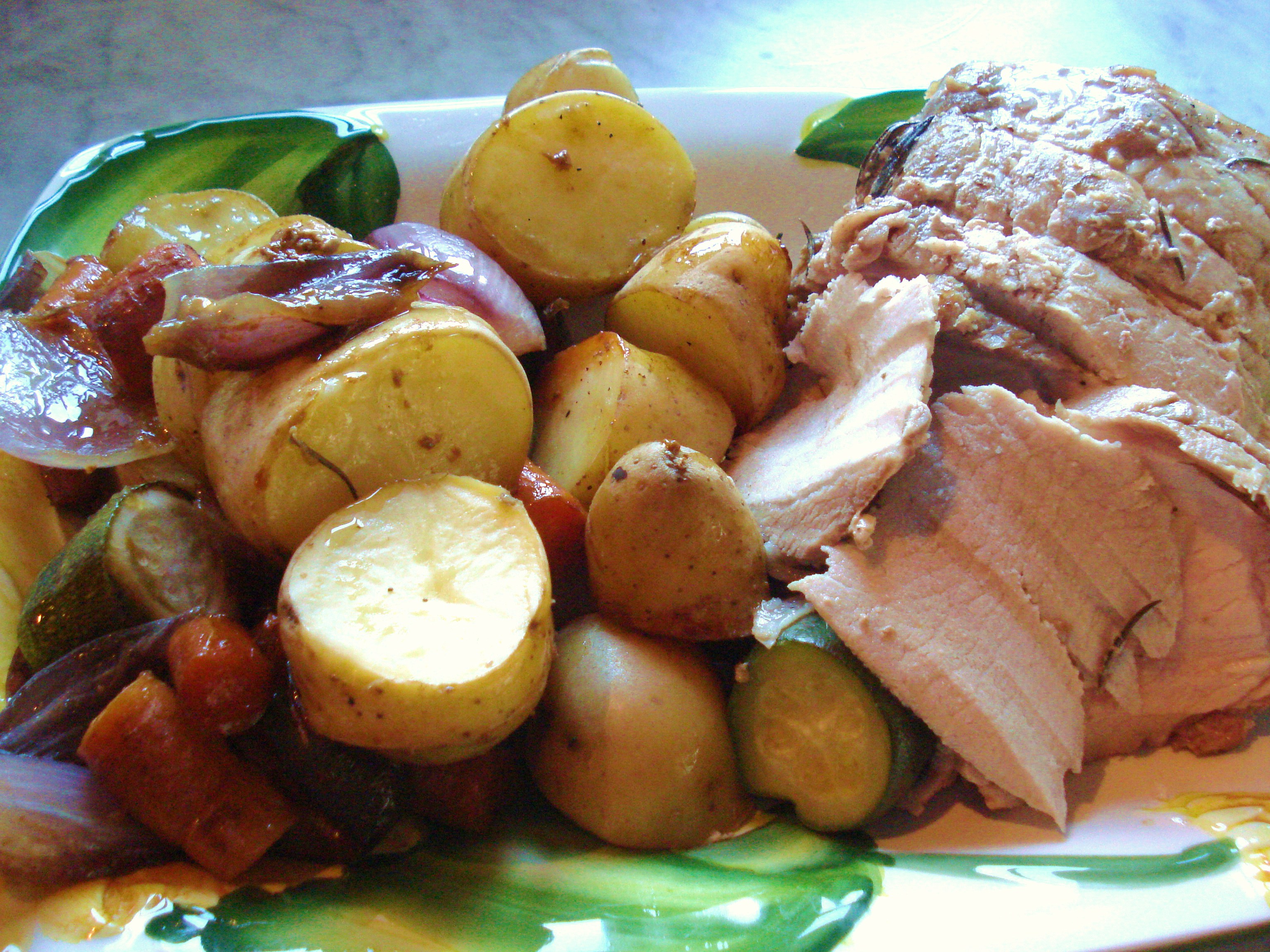
Pork & Roasted Vegetables

The preparation time for this dish is 5 minutes. The easiest dish to prepare and then into the oven for 1-1 1/2 hours. Read a book, watch a great movie, get office or house work done while your oven does the work!

Choosing a Pork or Beef Roast.  Allow for water loss when working with meat, measure 5 ounces per person.

Serving 6, 30 ounces or buy a 2 lb pork roast (900 g, round up to 1 Kilo of meat).

INGREDIENTS

3 onions peeled and quartered (Red or Yellow)
Do Not peel following vegetables to optimize flavor of dish.

  • 4-6 Red Potatoes washed and quartered
  • 4 Carrots quartered
  • 3 Zucchini’s quartered and lightly salted (removes bitterness)
  • Salt and Pepper to taste
  • 1 teaspoon Turmeric
  • 2  Garlic Cloves (peeled and minced)
  • 1/4 c. Olive Oil

Pork or Beef Roast (washed and patted dry with paper towels)

  • 1 tsp each Salt
  • 1 tsp dried Sage( or 1 Tbsp freshly chopped) .
  • 1/4 tsp Black Pepper
  • 3-4 Rosemary Sprigs
  • 1 1/2 c. Water
  • 2 Tbsp soy sauce for Pork Roast
  • 1 cup red wine for Beef Roast
  • 1 Tbsp vegetable oil

DIRECTIONS
Preheat oven to 450 F (232 C).

In an oven safe dish place washed and quartered vegetables. With a large spoon turn 1/2 tsp salt, 1/4 tsp pepper, 1 tsp turmeric, rosemary springs, garlic, olive oil into vegetables until they are well coated. Place into oven set at 450 F.

Place skillet on medium high heat for 1 minute and then add 1 Tbsp vegetable oil.  Add meat to skillet and sear each side for about 2 minutes. The meat is ready to turn when is easily releases itself from pan. (Don’t fight to detach! The meat will detach itself once completely seared on one side.)

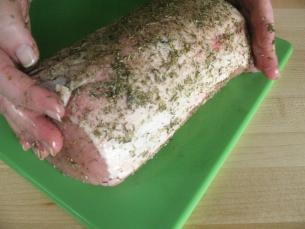
Rub seasonings onto Pork poast

In a bowl, mix 3/4 tsp, salt and 1/2 tsp pepper, 3/4 tsp sage. Rub seasonings onto all sides of roast. (Use all theseasoning!) In a roasting pan, rest 4 rosemary sprigs about 3-5 inches in length on bottom of pan, place pork, or beef roast on top.  Add water, soy sauce (or wine). Cover pan with aluminum foil and seal edges.

Leaving vegetables in the oven to continue baking. Reduce oven temperature to 325F (150C) when placing roast in the oven and bake roast  for 20 minutes per pound (450 grams). Internal temp. will reach 160 F or 72 C. Using oven gloves, carefully remove pan from oven and place onto a pot pad. Keep covered and allow roast to rest for 10 minutes. With a large meat fork and butcher knife thinly slice meat. Remove vegetables from oven and with large spoon, gently place vegetables around meat for presentation. Buon Appetito!

Easy Homemade Taco or Burrito Meat

Easy to make! From frying pan to dinner plate in 15 minutes! Serves 16 taco’s or burrito’s. A dinner party, or fun family weekend afternoon that can be  brought together last minute with minimal effort

1/3 c. Olive Oil
1/2 Onion diced (red or yellow)
2 Garlic Cloves (peeled and minced)
1 tsp Oregano
1 tsp Red Pepper Flakes
1 tsp Salt
2 pounds ground meat
1 c. Tomato Sauce
1/4 c.  Water
(Optional: Add in red beans, red bell pepper diced and a celery stick sliced small.  Increase spiciness with 1 tsp cumin, or 1/2 tsp more of red pepper flakes.) 

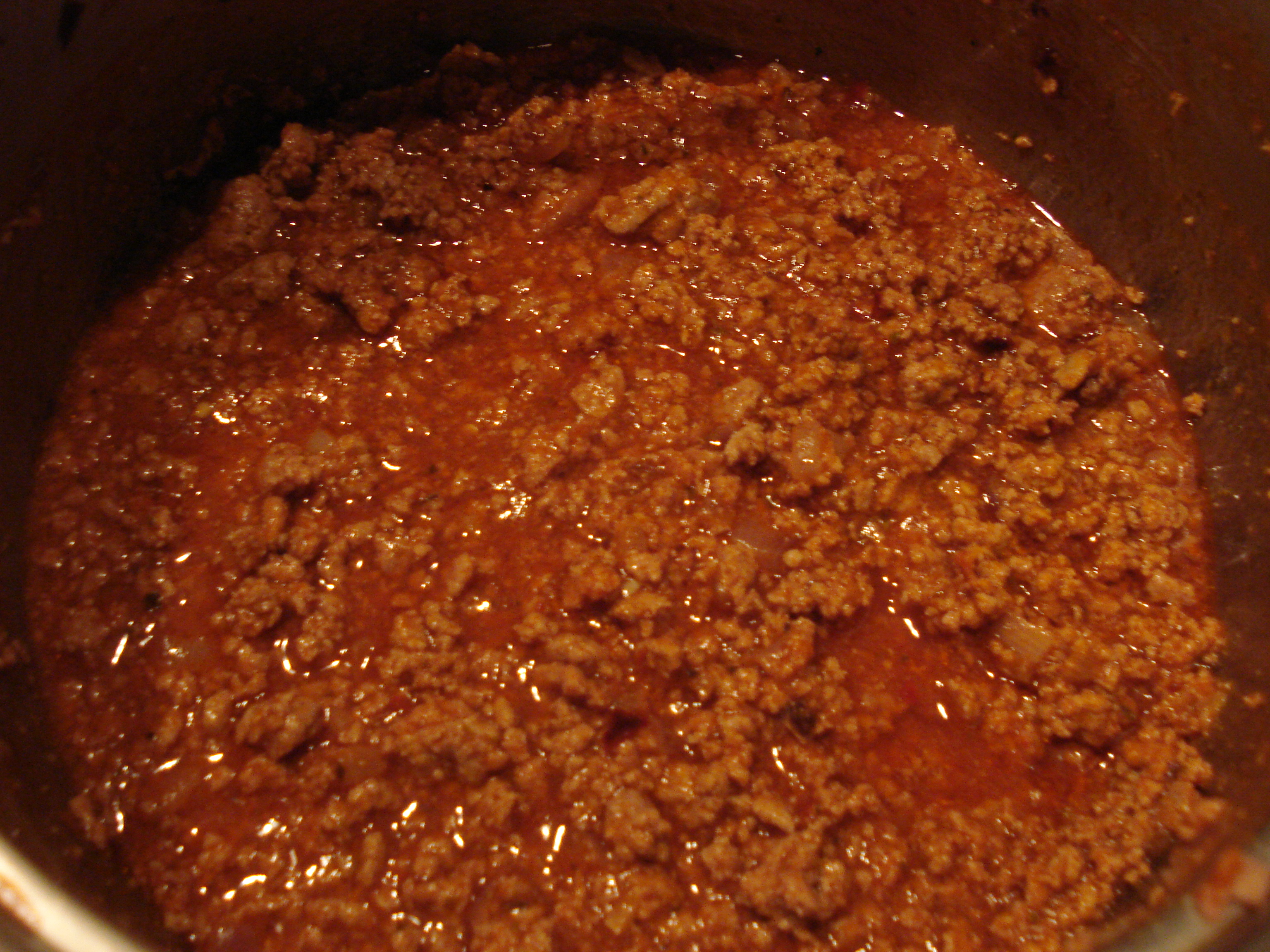
Herbs & Spices makes this meat sauce delicious!

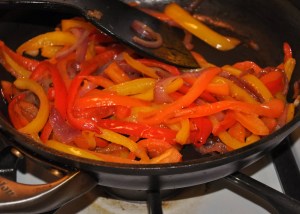
Add in peppers as part of the sauce, or serve them as a topping.

On medium heat, place in a frying pan: onion, garlic, oregano and pepper flakes in olive oil, allow to saute` for 4 minutes. (next, may add in vegetables with cumin and allow to cook for 5 minutes) Add ground meat breaking it down with wooden spoon until brown and crumbly. Add salt, tomato sauce and water, stirring, incorporate all ingredients, cover and allow flavors to come together for 5 minutes.Remove from heat and turn off stove.

Prepare your taco and burrito topping the meat sauce with favorite toppings: sliced avocado, tomato, pepper sticks, lettuce, re-fried beans, rice, bacon, cheese, guacamole, mayonnaise or sour cream.

If sensitive to spicy foods, drink a glass of milk with your dinner. The milk fat covers the acidity of tomato seeds combined into tomato sauce and also calms the strength of the spice so that digestion is easier on those with lower tolerance of spicier foods.

ADD ON TO YOUR PARTY WITH:
Paratha
Feeling adventurous! Make your own burrito style bread; bringing a bit of Indian cooking to your table.

Cucumber Guacamole Dip

Sangria’s Best

The Olive Tree

A handful of olives each day improves the health of the body.

The history of the sacred olive tree’s goodness extends from peace offerings between “The Powers” of countries and cities, to its fruit’s medicinal benefits.  Before presenting how the olive is processed, enjoy some trivia on the olive tree and it’s influence on society.

  1. Genesis states that Noah received an olive branch from a dove once the flood waters receded. Christians continue with the tradition of exchanging small olive branches as a sign of peace one week before Easter.
  2. The name Athena is said to bare the name of the Olive Tree with the Olympic Crown being made of olive branches.
  3. Olympians  and other individuals used olive oil to make their skin more supple.
  4. Extra Virgin Olive Oil (EVOO) is used as a medicine in order to improve healthy cholesterol (HDL) and reduce the bad cholesterol (LDL). The quality of nutrient’s work as a hammer and chisel, helping to reduce plaque build up in veins and arteries.
  5. Thousands of  years of history and research have shown the importance of olive oil. World history indicates that in 2000 b.c. Egyptian’s imported Olive Oil from Crete, Syria and Canaan.

Generations of farmers and their  knowledge on handling of the fruit is passed down through time and right to our kitchens where the tree of life provides us with vitamins and minerals that satisfy our bodies keeping them healthy and strong.
EVOO a.k.a. Liquid Gold

Homer called it “Liquid Gold” and so the name stuck since Greek times. Extra Virgin Olive Oil, a name from “Oleum” (oil ) Gk and “Elaion” (olive tree ) Gk, originates from “El’yon” (meaning superior) Gk. Todays largest producers of Olive Oil are: Spain, Italy and Greece. Spain & Italy perform multiple presses on olives, while Greece is the number one  producer of Extra Virgin Olive Oil (a single first press).

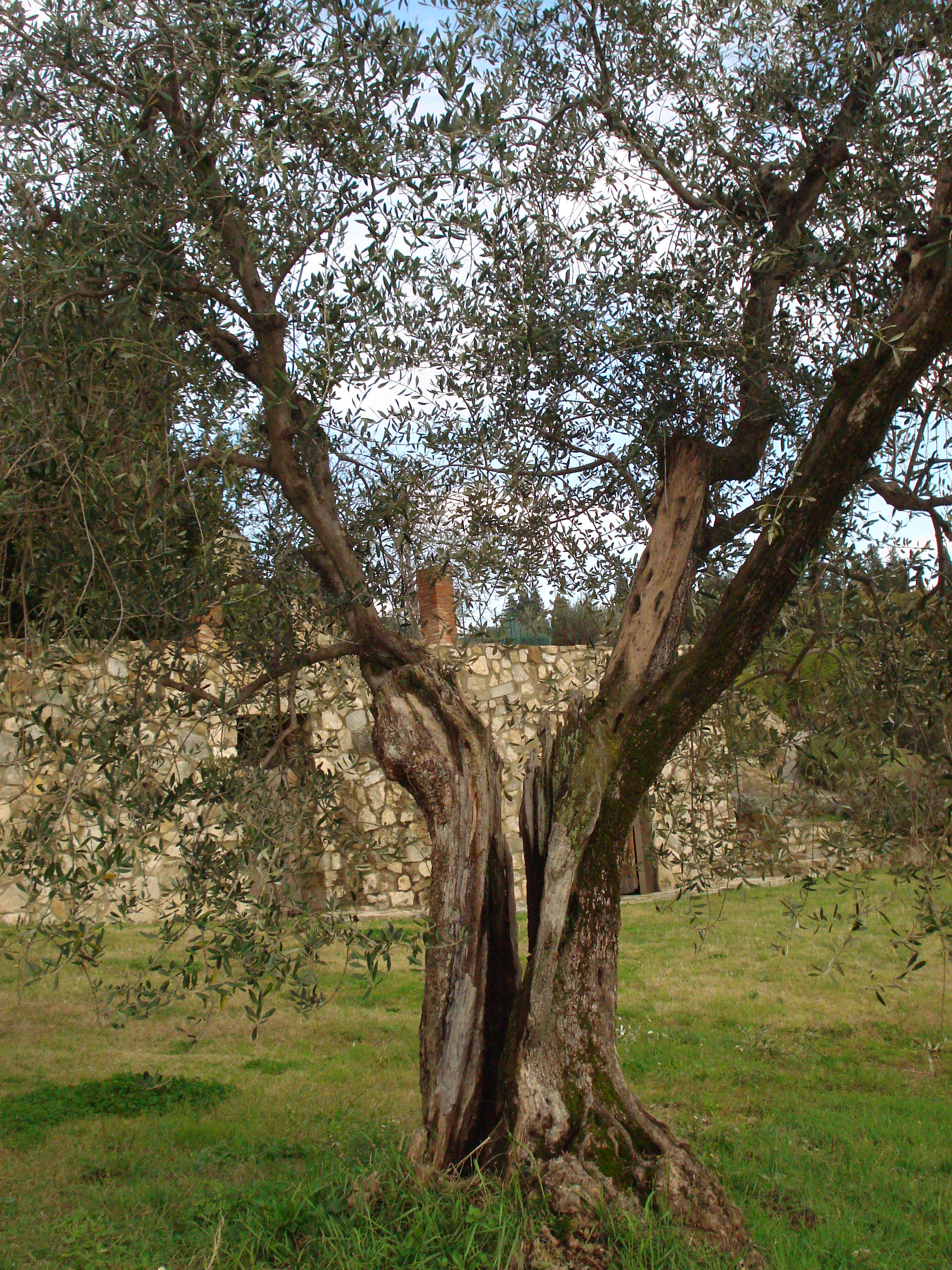
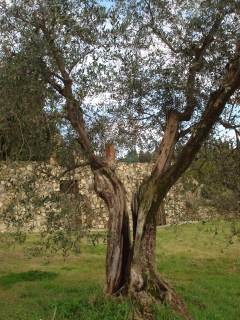
Olive trees are pruned yearly. The height of fruit production is 20-25 years per branch and then it is removed. By alternating the cultivation of branch shoots, olive trees can live 300-600 years.
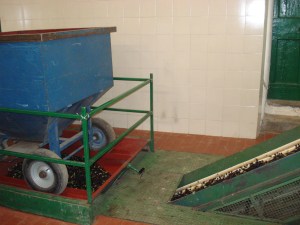
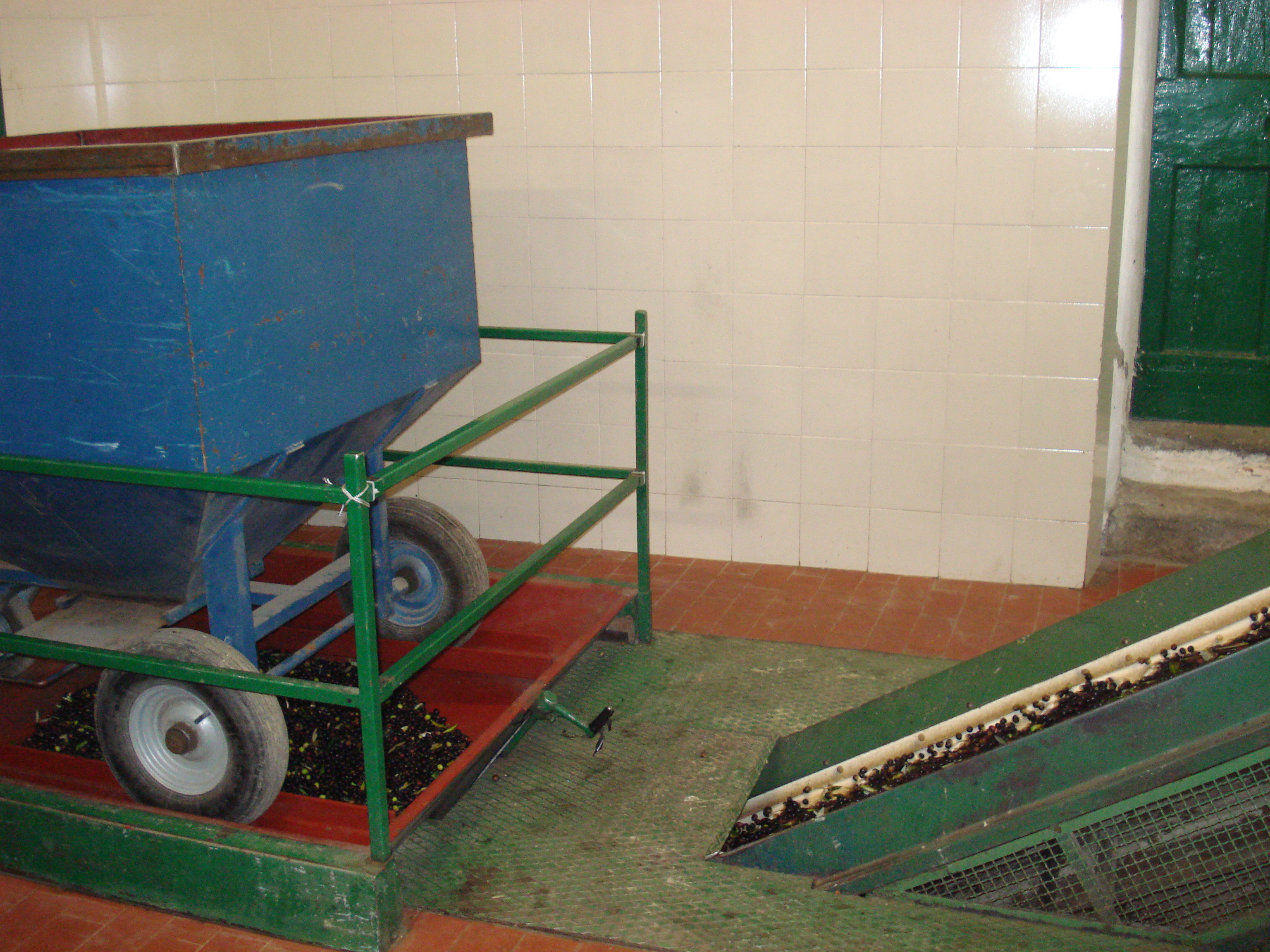
Olives await their press

In late fall and early winter, large nets are spread around the tree, olives are combed from the branches with rakes, combs or shakers, then placed into a large wagon. They await their press within the first 24 hours of being collected. The olives are removed from the wagon and elevated into a wash bin, separated from leaves and insects, ready for press.

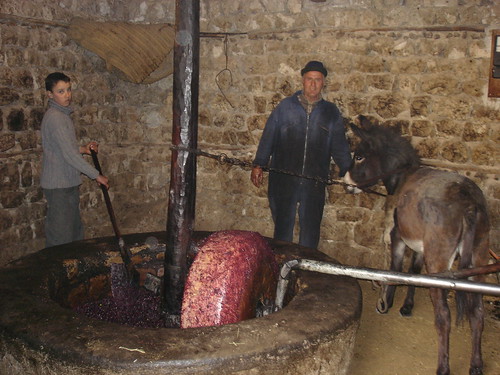
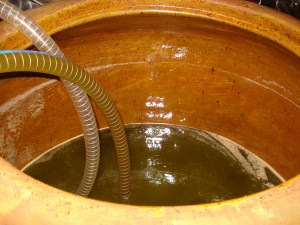
Old olive press

Olive presses have evolved over time! Two stone wheels once stood vertically to each other with a large pole balancing them in the center. A donkey was roped onto the pole and would walk in circles, causing the wheel to rotate and press the olives, resulting in a beautiful green ribbon oil streaming from the attached siphon. Archaeologists found 100 olive oil presses dating back to 1600 b.c. in “the fertile crescent”, the stomping grounds of Lebanon, Israel and Palestine. The ancient presses would have produced between 1,000 to 3,000 tons of olive oil per season.
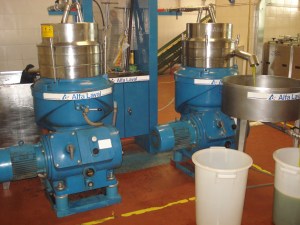
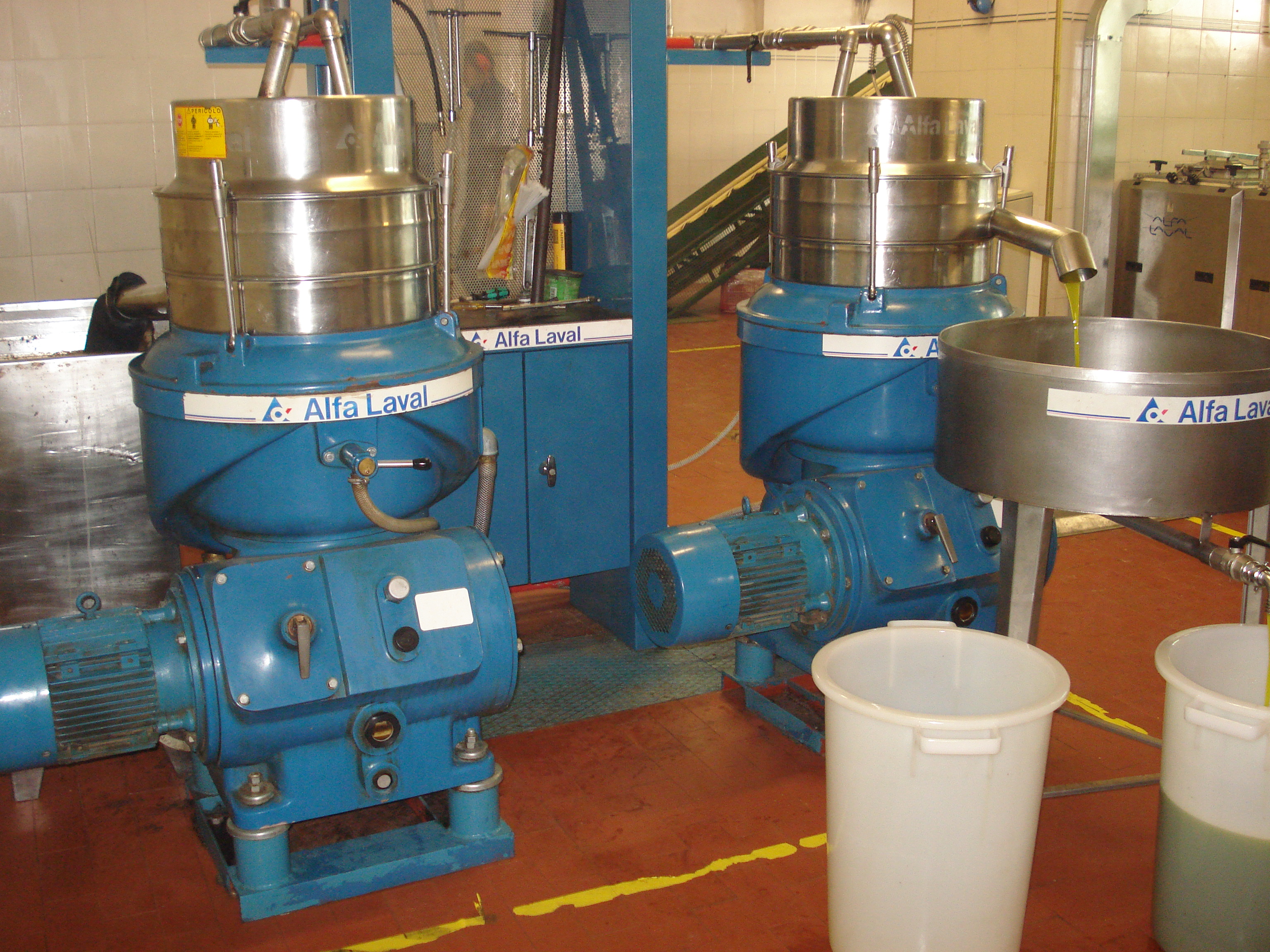
Once in press, the water and oil are separated from the olive.

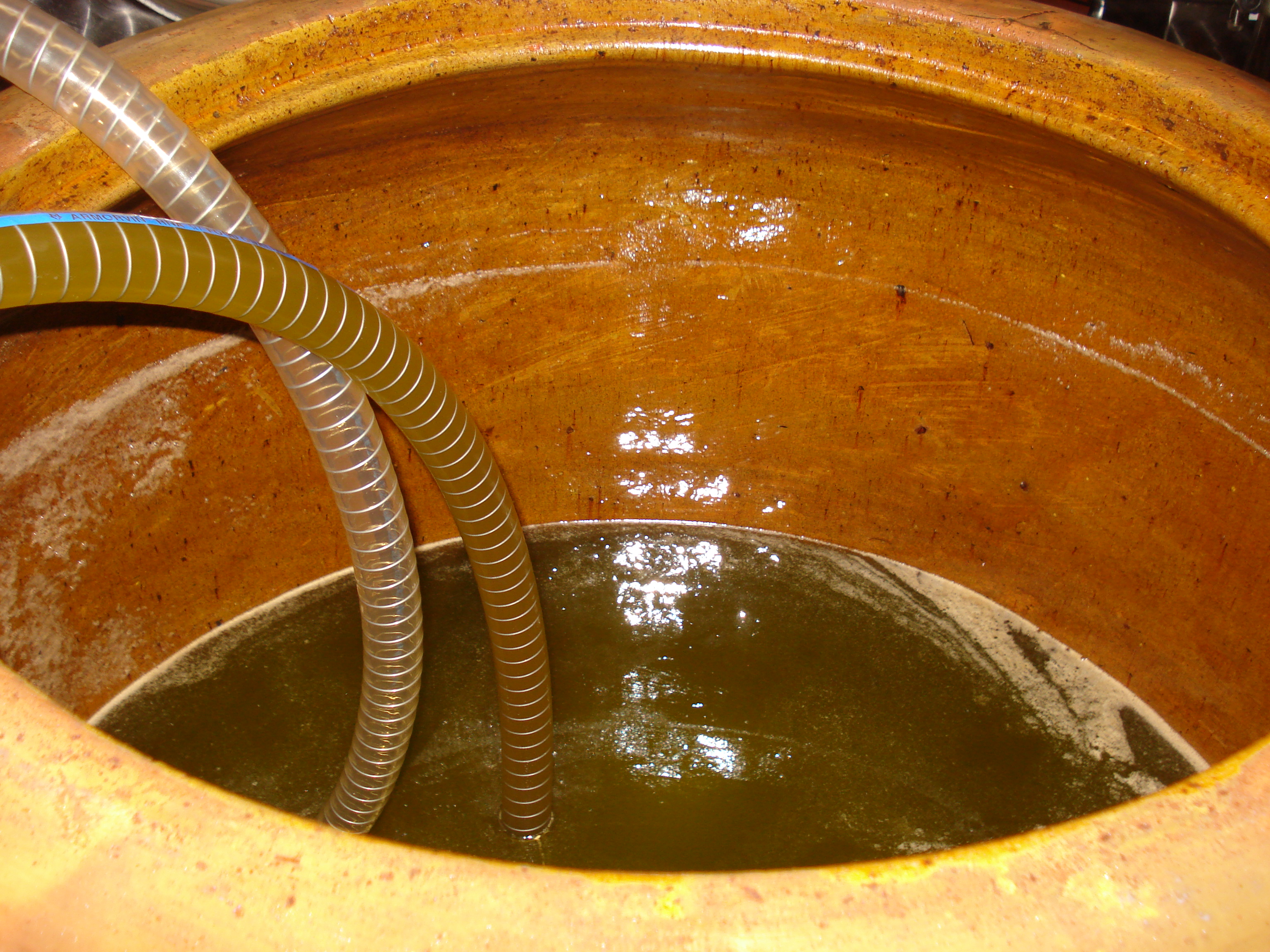
Today olives are more easily pressed with their oil extracted and water being separated from the fruit. There are 3 presses performed on a single olive in modern times. Description of “Cold Press Oil” is reference to when the olives were obtained and pressed; November-January for most countries north of the equator! Looking through the screen, one can observe the pressing of the olives! The filaments are an earth color, soon to come out yellow-green as the pits and olive skin are sorted from the oil.
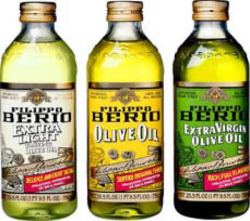
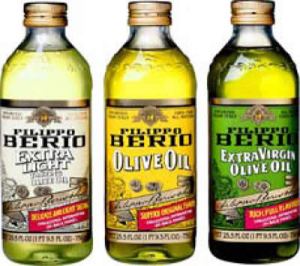
Olives endure 3 presses. The virgin press has the highest quality of nutrients and is dark yellow-green in color.

Extra Virgin Olive Oil has a color of dark yellow-green and holds a superior quality in vitamins and minerals. It is preferred to NOT HEAT EVOO, but instead use it on fresh on salads, vegetables and breads. Second press, a pale yellow oil, is used for low-heat sautéing of garlic & onion, a precedent to sauce making. Third press, yields clear oil, considered a poor quality with very few nutrients, often combined with a pat of butter for frying. Understanding olive oil and how or why it is used in various recipes provides one an opportunity to achieve the best dietary results in keeping a  family healthy.
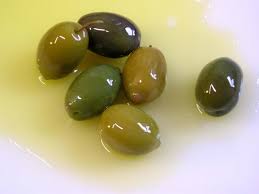
1 serving a vegetables= 4 olives. Replace butter intake with EVOO to improve skin

Europe has many wonderful olive orchards.  A special thanks to Villa Maiano (Florence, Italy) and an opportunity to visit to their Olive Orchard and access to their farm.  http://www.fattoriadimaian​o.com/en/

Recipes

Recipes for Extra Virgin Olive Oil (EVOO)
DRESSING or DIP:

  • Whisk together 1 Tbsp EVOO, 1/2 Tbsp balsamic Vinegar, pinch of salt and pepper, 1 tsp parmesan cheese and serve on baguette or salad.
  • Vegetable salad. 1 tomato diced, 1 cucumber peeled and diced, olives, 1/2 c. arugula leaves. Combine with 1 Tbsp EVOO, pinch of pepper and oregano.
  • Salmon and Mozzarella
  • Cucumber Guacamole Dip

Recipes for Second Press Olive Oil

Recipes for Third Press or Light Olive Oil

OLIVE OIL can be used by itself  in place of facial creams.  Please read more and learn how to save money be making your own home remedy; a daily application before bed time is enough to improve skin.  Home Remedy Facial! Stimulate Your Skins Collagen & Elastin
Written by Kimberly Crocker Scardicchio

Remove Alcohol for Quick Weight Loss

A fast approach to weight loss is by halting drinks that can influence weight retention. Alcohol is the most social and common kind of ‘drug’ we can take, and it’s a normal part of our society and socializing to have a few drinks. We’ve been drinking alcohol for centuries from simple fermented drinks to classy wines, champagnes, and exotic cocktails. There are obvious health and social problems associated with excessive or binge consumption of alcohol, but what about its effects on people aiming for weight loss?

All alcoholic drinks contain a significant amount of calories per serving, and we often have a lot more than just one serving! But how much damage does this do for your weight loss efforts? An ideal dietary plan reduces calorie intake by 250-500 calories per day to achieve a good amount of healthy weight loss per week.  One can easily see that 1-2 drinks per day puts pay to any good nutrition plan you might follow during the day. Simply said: 1-2 alcoholic drinks can seriously halt weight loss.

Another way to look at the effect alcohol has on weight loss is to compare the equivalent time needed to spend doing fitness training to burn these calories off! An individual of average fitness level and of average weight would apply the following effort to burn off 2 alcohol servings:

Training time required to burn off calories from alcohol:

Alcoholic drink Walking Swimming Running Cycling
Beer (355ml) 30 mins 17 mins 12 mins 13 mins
Light beer (355ml) 20 mins 11 mins 8 mins 9 mins
Low carb beer (355ml) 23 mins 13 mins 9 mins 10 mins
White wine sweet (200ml glass) 40 mins 23 mins 16 mins 18 mins
White wine dry (200ml glass) 29 mins 16 mins 12 mins 13 mins
Red wine (200ml glass) 28 mins 16 mins 11 mins 12 mins
Spirits (on ice / neat) 13 mins 7 mins 5 mins 6 mins
Water 0 mins 0 mins 0 mins 0 mins

There’s a lot of work to be done if  a few (or more) drinks are consumed. Think of all the blood, sweat, tears, and hard work that can go into a great fitness session….and how easily the efforts  can be reversed by drinking alcohol!  Additionally, alcohol contains no essential nutrients and reduces the absorption of Vitamins A, D, E, K, folate, B I, and B2 by altering Biotin (B7).  Lastly, alcohol does not contribute to muscle glycogen, so you may be left short on carbohydrates (Fruits, Vegetables and Whole Grains), which you need in order to train hard.

While it is true that red wines contain a natural phenol “resveratrol”, which permits blood cells to smoothly pass each

Handful of blueberries for improved health.

other instead of sticking to one another,  consider trading in your wine glass for fiber.  Resveratrol is also found in peanuts, soy, cranberries, blueberries, and Itadori tea which maybe a good substitute for red wine and linking it to possible human longevity.

By gaining knowledge on how to improve weight loss efforts, you can begin to feel better about your own appearance and body’s health over the next week, as your initial loss can be 2-7 pounds within the first days of working towards your new objective!

By: Kimberly Crocker

References:

Beauty of Wine and Grape Juice

Vitamin “H” for Haar and Haut

http://www.completefitness.com.au/articles/nutrition/alcoholweightloss.php

Vitamin “H” for Haar and Haut

European spa’s know it and sell it at their Benessere Resorts (well-being)!  The style toted by european women is practiced weekly as they go to local salons and focus on their natural beauty. When referencing the body it’s as simple as name dropping, just say the German words “Haar and Haut” and you have “Hair and Skin”.

Vitamin H derives its name from Haar and Haut (also known as  Biotin/B7) therefore, this vitamin  is critical in the making of:  skin, hair cells, breaking down fats and producing fats metabolized from protein/amino acids as it assists key enzymes (carboxylase) to produce what is necessary for life.

Carefully understanding the word metabolism allows for easier comprehension on how and why we can better do better in improving or maintaining a lean machine.   Metabolize comes from the Greek word Metabole meaning Change.

We count on our metabolism, to break down carbohydrates, proteins, and fats into smaller units; those units are reorganized as tissue building blocks (or as energy sources) and then waste products are eliminated and removed based on what our body cannot use.  In order for a body’s enzyme’s or hormone’s to do all this work, it needs an assistant  (referred to as co-enzymes) like biotin so that principle enzymes can participate in the production and building of healthy bodies.

Foods rich in Biotin

Improving  daily intake of vitamin H  is easy to do by choosing one of the following foods and including it into a well rounded diet.  Best foods for Biotin/Vitamin H/B7  are:  cooked egg yolks and whites, liver, fish, peanuts, peas, cauliflower, corn and grains. Biotin is produced in the intestines through bacteria as well. Vitamin B7 is also found in synthetic form.
Interference of proper uptake of vitamin B7 can happen through consumption of alcohol, which limits or prohibits the co-enzyme to function, as well as eating of raw eggs.  Research shows  that the raw egg white holds the  protein Avidin which can  interfere with Biotin which is found in the egg yolk.  Therefore, it’s advised that if biotin deficiency is determined in an individual, that one should cook the egg so that avidin is denatured upon cooking, while biotin remains intact.  Those who are pregnant, lactating, or athletic may need extra vitamin B7 and should consult their doctors to have their levels of biotin checked.
Biotin/B7 deficiency can be noted by causes of skin rashes (dermatitis), nail and hair (alopecia) loss, conjunctivitis (pink eye) and tingling in extremities.  It may also result in weakness, depression, hallucination, numbness, fatigue, irritation, rashes, loss of appetite.
We can still enjoy the care of “Haar and Haut” at our local hair salons for cuts, pedicures and manicures! However, with accurate dietary information in hand, knowledge and proper care of oneself  can improve lifestyle and attention to what will bring about physical success.
By:  Kim Crocker-Scardicchio
References