Glycemic Load and Glycemic Index Recommendations

 Great way to lose weight, control heart problems and diabetes.
 Plan healthier meals utilizing the Glycemic Index
The Glycemic Index (GI) is a unique system that gives values to carbohydrates such as breads, fruits and vegetables so that you can understand how rapidly a carbohydrate turns into glucose.  Learning about the foods that contribute to excessive sugar circulation in your blood stream will assist in better understanding the foods that can benefit or work against the body.

Blood sugar must be maintained at a certain level, the brain signals the pancreas to release insulin, in order to breakdown food and bring the blood levels down to normal range by then converting excess sugar to fat.

Carbohydrates that break down quickly during digestion are given higher glycemic values (indices), while others that breakdown slowly receive lower glycemic values (indices). Once understood and put into practice, you may choose to not go back to eating the same way as before, but instead, properly monitor the nutrition intake in order to prolong the onset of diabetes.

Foods that break down rapidly:
Remove white breads, sugars.
Reduce or remove starchy vegetables: potatoes, corn, peas, various beans, winter squash, plantains, and yucca.
Reduce or remove certain fruits: Oranges, Pineapples, Bananas and other citrus foods, Apples, Pears, Peaches, Grapes, Strawberries, Blueberries, Cherries

Avoid eating foods with the following added ingredients: Fructose, Maltose, Sucrose, Corn Syrup and Gluten. It is highly advised that ALL food ingredients are reviewed before purchasing, including nuts and seeds.

Foods that break down slowly:
Whole grains and varied vegetables.
Add in fruits that are sour to taste: Apricots, Plums, Kiwi, Raspberries, juice of fresh Lemon or Limes sprayed onto meats, fish, poultry.
Add to juice of lemon to drinking water.
Add Cardio Exercise to your daily routine; heart rate should increase by 80% over normal resting heart rate and maintained for 30 minutes.

What is the glycemic load (GL)?

  • The Glycemic Load (GL)  is then defined by the total amount of carbohydrate contained in a specified serving of a particular food.
  • GL = GI  x grams of carbohydrate per serving/100
Glycemic Index (GI) Range Glycemic Load (GL) Range Glycemic Load per Day
Low GI = 55 or less Low GL = 10 or less Low GL < 80
Medium GI = 56-69 Medium GL = 11-19 High GL > 120
High GI = 70 or more High GL = 20 or more

It would be ideal to stay on a low glycemic diet which reflects eating food with a value given under 55. With a total low glycemic load of an optimal value of 80-120 per day.

CALCULATING A GLYCEMIC LOAD
Glycemic Load = Glycemic Index  x  Available Carbs (grams)/100
Example
Glycemic Index (GI) of 1 cup of banana is 51.4 (or 52)
Carbohydrate content of banana 45.5 ( 51.4 GI – 5.9 fiber = 45.5 carbs)
Glycemic Load = 52 GI x 45.5 Carbs/100 = 24 GL

Glycemic Food Index and Load provides a thorough list of foods with the Glycemic Load number to assist in making a more clear choice for your meals.

Foods that lead to a higher Glycemic Index and Glycemic Load Value
Food
Glycemic Index
(Glucose=100)
Serving size
Carbohydrate per serving (g)
Glycemic Load per serving
Dates, dried
103
2 oz
40
42
Cornflakes
81
1 cup
26
21
Jelly beans
78
1 oz
28
22
Puffed rice cakes
78
3 cakes
21
17
Russet potato (baked)
76
1 medium
30
23
Doughnut
76
1 medium
23
17
Soda crackers
74
4 crackers
17
12
White bread
73
1 large slice
14
10
Table sugar (sucrose)
68
2 tsp
10
7
Pancake
67
6″ diameter
58
39
White rice (boiled)
64
1 cup
36
23
Brown rice (boiled)
55
1 cup
33
18
Pasta, semola/white; boiled 10-15 min
44
1 cup
40
18
Pasta, semola/white; boiled 5 min
38
1 cup
40
15
Pasta, whole wheat; boiled
37
1 cup
37
14
Rye, pumpernickel bread
41
1 large slice
12
5
Oranges, raw
42
1 medium
11
5
Pears, raw
38
1 medium
11
4
Apples, raw
38
1 medium
15
6
All-Bran™ cereal
38
1 cup
23
9
Skim milk
32
8 fl oz
13
4
Lentils, dried; boiled
29
1 cup
18
5
Kidney beans, dried; boiled
28
1 cup
25
7
Pearled barley; boiled
25
1 cup
42
11
Cashew nuts
22
1 oz
9
2
Peanuts
14
1 oz
6
1

It is important to follow the glycemic load if you have been identified with insulin resistance, pre-diabetes, diabetes or need to lose weight.

REFERENCES

GI and GL Range Values.  Chart provided by: University of Michigan
Glycemic Index Chart provided by the University of Sydney, Australia
http://www.med.umich.edu/umim/clinical/pyramid/grains.htm
http://www.glycemicindex.com/
http://lpi.oregonstate.edu/infocenter/foods/grains/gigl.html
http://www.nutritiondata.com/topics/glycemic-index
http://www.sharecare.com/question/is-insulin-resistance-diabetes
Diverticulitis and Diverticulosis Diet Tips

 
Diverticula are small pouches in the wall of the digestive tract. They occur when the inner layer of the digestive tract bulges through weak spots in the outer layer. (This is similar to what happens when an inner tube bulges through a tire.) People who have these pouches are said to have diverticulosis. Sometimes one or more of these pouches becomes inflamed or infected, a condition called diverticulitis. Some people with diverticulosis become aware of the condition only when diverticulitis occurs.
Diverticulosis is a very common condition in the United States.
Diverticulosis is more common in developed or industrialized countries, such as the United States, England, and Australia, where the typical diet is low in fiber and high in highly processed carbohydrates, diverticulosis is common. Diverticulosis first appeared in the United States in about 1900. This was the same time that processed foods were first introduced into the US diet.
Diverticulosis is much less common in countries of Asia and Africa, where the typical diet is high in fiber. (For more information on diverticulitis, check with the Mayo Clinic at http://www.mayoclinic.com/health/diverticulitis-diet/HQ00548)

Most people recover from diverticulitis without problems if they receive appropriate treatment. Diverticulosis and diverticulitis can be prevented by changes in lifestyle and habits.

Diverticulosis is thought to be caused by increased pressure on the intestinal wall from inside the intestine. As the body ages, the outer layer of the intestinal wall thickens. This causes the open space inside the intestine to narrow. Stool (feces) moves more slowly through the colon, increasing the pressure. Hard stools, such as those produced by a diet low in fiber or slower stool “transit time” through the colon, can further increase pressure. Frequent, repeated straining during bowel movements also increases pressure and contributes to formation of diverticula.
Diverticulosis in developed countries is blamed largely on the typical diet, which is low in fiber. For more information on Diverticulosis.

Diet Plan for Diverticulitis

  1. Grains
    enriched refined white bread, buns, bagels, english muffins
    plain cereals e.g. Cheerios, Cornflakes, Cream of Wheat, Rice Krispies, Special K
    arrowroot cookies, tea biscuits, soda crackers, plain melba toast
    white rice, refined pasta and noodles
    avoid whole grains as the seeds can get add to the inflammation within the intestine.
  2. Fruits:
    fruit juices except prune juice
    applesauce, apricots, banana (1/2), cantaloupe, canned fruit cocktail, grapes, honeydew melon, peaches, watermelon
    avoid raw and dried fruits, raisins and berries.
  3. Vegetables:
    Vegetable Juices
    Potatoes no skin
    beets, green/yellow beans, carrots, celery, cucumber, eggplant, lettuce, mushrooms, green/red peppers, potatoes (peeled), squash, zucchini
    avoid vegetables from the cruciferous family such as broccoli, cauliflower, brussels sprouts, cabbage, kale, Swiss chard etc
  4. Meat and Protein Choice:
    Well done, tender meat (lean), fish (wild caught) high in Omega 3 which will reduce inflammation within intestine. eggs
    Avoid beans & lentils
    Avoid all nuts and seeds, as well as foods that may contain seeds (such as yogurt)
  5. Dairy
    Two servings per day skim or 1% milk
  6. FATS
    Avoid saturated fats such as butter, margarine, Trans Fats, mealt high in fat content.
    MCT oil is most gentle on the intestine. You can also try plant oils. Extra Virgin Olive Oil, canola, avocado and peanut oils.

By: K. Crocker

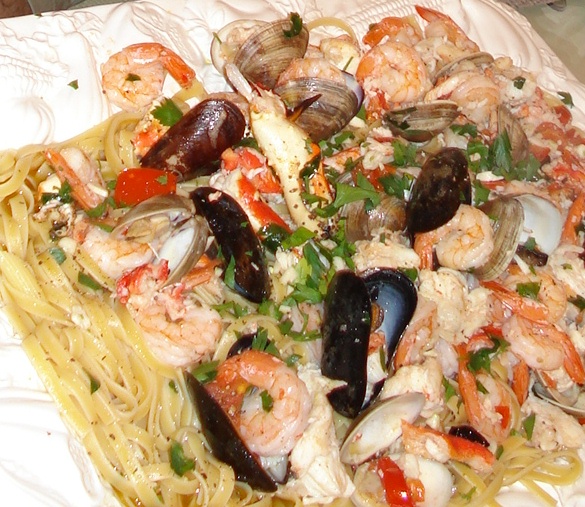
Italian Seafood Pasta

dsc01842-2.jpg

Italians enjoy their surf and turf!  This plate includes: Shrimp, Mussels, Clams, Crab and Lobster. Prep time 5 minutes. Cooking time:  15-20 minutes from stove to table!  This recipe maybe used exclusively for any single item of seafood of your choosing. (ex. Only clams or mussels (use 2 lb.’s) or shrimp (Use 1 -2 lb’s).  Don’t forget to choose a wine

Serves 6 people

  • 4 garlic cloves (minced and set aside. use half for initial sauté, remaining half is added at the end or recipe.)
  • 1/2 cup Olive Oil
  • 1/2 onion chopped
  • 4 Tbsp Parsley ( chopped and set aside)
  • 360 g of Barilla Pasta (Spaghetti or Fettuccine)
  • 1 Tbsp salt
  • 1/2 pound cherry tomatoes (optional)
  • 1/2 lb Clams
  • 1/2 pound Mussels
  • 3/4 cup cream (optional)
  • 1-1/2 cup wine. (0ptional)
  • 1 Lobster Tail (meat loosened and removed from shell)
  • 1/2 pound Shrimp (peeled) or Pre-Cooked Shrimp
  • 1 pound Crab Legs
  • 1 tsp Salt & Pepper to taste.

BEGIN

In one large pan start to boil water.

Place clams and mussels in a colander, wash and scrub shells with cold water.

Second large pan: Healt 1/2 cup Olive oil on Medium heat with two garlic cloves for 3 minutes. Remove from heat.

Add onions,  1/2 lb. Raw Shrimp, Mussels and Clams (and tomatoes optional).  Return pan to medium heat. FYI: Immediately cover dish to avoid hot oil splatter. Pour cream and wine onto fish. Cook together for 3 minutes.

At this time remove pasta from box and add Pasta ( Barilla Spaghetti or Fettuccine) to salted (1 tbsp salt) boiling water allow to boil for 8 minutes.

Place loosened lobster meat from the lobster tail, Pre-cooked Shrimp, Crab and 2 minced garlic cloves and parsley to the cooking mussels and clams. Allow to warm together for 2 minutes.  Add 1 tsp Salt and Pepper to taste.  Cover remove turn off heat. Add 2 ladles of pasta water to simmering seafood.

Drain water from pasta and Add Pasta to seafood carefully turning both, incorporating seafood and pasta together for about 2-3 minutes.  Drizzle fresh oil on seafood and pasta garnish with chopped parsley.

Buon Appettito!

By Kimberly Crocker