Phyto Estrogens You Should Eat

Estrogen’s Role in the Female Body

Estrogen is a hormone that is produced in our bodies and is critical to the function of our
sex organs. Produced within the ovaries of child bearing women, it controls the uterine lining growth and interacts with progesterone to make ovulation possible. During pregnancy it stimulates the maturation of the fetus, the growth of the placenta and the change in the breasts.
THE DOWN SIDE OF ESTROGEN
Most women at one time or another will suffer from: headaches before a period, breast tenderness, urinary stress incontinence, mood swings and hot flashes, inability to properly absorb calcium can all be attributed to a drop in estrogen.
 As one ages, estrogen diminishes and often times Hormone Replacement Therapy (HRT) medication  is initiated by the doctor.
INTRODUCING PHYTO ESTROGENS
The conversation is shifting and research is showing that there is a natural HRT called Phyto Estrogens. Phyto-estrogens are naturally occurring chemicals and are commonly known as iso-flavones, flavones, coumestans and ligans. Phtyo-estrogens have a chemical structure that is similar to that of “human estrogen” producing the same estrongenic and anti-estrogenic effect that the body would other wise produce at it’s own normal level of estrogen.
WHO SHOULD TAKE PHYTO ESTROGENS?
Women of all ages should be adding a variety of fruits, vegetables and nuts into their daily intake of food. It has been shown that women who eat flaxseed, soy or algae during peri-menopause have and easier time of going through menopause and many symptoms are greatly reduced!
WHERE CAN YOU BUY PHYTO ESTROGENS?
Look no further than your garden or local grocer! Studies were performed on 120 foods including: nuts, herbs and beverages. Researchers found that the phyto-estrogens are found in abundance in both Flaxseed and Soy. While other foods such as: vegetables, fruits and nuts contain lesser amounts, however, they are an equally important part of our daily dietary intake.
OTHER BENEFITS OF EATING PHYTO ESTROGENS
Studies have shown that a dietary increase in phyto estrogens leads to reduce incidence of breast and prostrate cancers, cardiovascular disease, osteoporosis and menopausal symptoms. Women are turning to phyto estrogens in place of Hormone Replacement Therapy (HRT) and Doctors are also noticing reduced cholesterol serum levels in patients who add more phtyo estrogens to their meals.
ADDITIONAL STUDIES FOR WOMEN
Further research performed on a global level are showing that phyto estrogens taken along with in-vitro fertilization (IVF) has a positive impact on producing a vital pregnancy. Each pregnancy is unique and pursuit of further information should be discussed between the patient and the doctor.
FOODS THAT COULD LOWER ESTROGEN:  Berries, Broccoli, Rutabaga, Bok Choy, Mushrooms.  HERB SUPPLEMENTS TO AVOID: Soy, Palmetto, Red Clover, Black Cohosh, Mexican Yam. AVOID ALCOHOL.
WHICH PHYTO ESTROGEN IS BEST FOR ME?                                                           
A variety of foods listed below allows individuals to accomodate their own tastes and improve their health by choosing from foods that have higher amounts of phyto estrogens.
  • Flax Seed
  • Soy/Soy Nuts
  • Tofu
  • Soy Yogurt
  • Sesame Seed
  • Flax Bread
  • Multigrain Bread
  • Rye Bread
  • Soy milk
  • Algae
  • Miso Soup
  • Hummus
  • Garlic
  • Mung Bean Sprouts
  • Alfalfa Sprouts
  • Dried Dates/Prunes/Apricots
  • Sunflower Seed
  • Pistacchio
  • Hazelnuts
  • Walnuts
  • Cashew
  • Chestnuts                                                                                                                       
  • Olive Oil & Olives
  • Almonds
  • Winter Squash
  • Green Bean
  • Collards
  • Cabbage
  • Lentils
  • Peanuts
  • Black Bean
  • Onion
  • Corn
  • Peaches
  • Watermelon                                                                                                       
  • Coffee
  • Milk
  • Red and White Wine
  • Green and Black Tea
  • Beer
REFERENCES

High levels of phyto estrogens can interfere with proliferation. Research: Obstetrics and Gynecology University of Rockstock, Germany http://www.ncbi.nlm.nih.gov/pubmed/12820351                                                                The Risk of high amounts of phyto estrogen may reduce maintenance of pregnancy http://www.ncbi.nlm.nih.gov/pubmed/19165661

Increased rates of phyto estrogens used to assist in IVF pregnancies  Research: Obstetrics and Gynecology Rome, Italy http://www.ncbi.nlm.nih.gov/pubmed/15589851

Adding Phyto Estrogens to IVF may improve chances of vital pregnancy. Research: Obstetrics and Gynecology, Women’s Health Care Center, Assuit University, Egypt http://www.ncbi.nlm.nih.gov/pubmed/18413068

Phyto estrogen taken over time reduces risk of breast cancer. Research: University of Sydney, Australia http://www.ncbi.nlm.nih.gov/pubmed/17176212

Pizza Napoletana

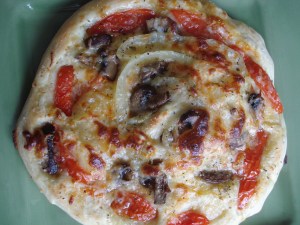
Pizza Personalized! Enjoy a simple Margherita or your favorite toppings.

Enjoy a Pizza from Naples on your grill this summer, or from the oven! This recipe can be enjoyed by utilizing a few simple ingredients and very little effort, serves 4.

May be prepared by hand, or with a kitchen mixer by using the bread hook and setting the mixer on stir in 4 minutes.  The dough does rises in 30 minutes.

If living in Europe, the common Fresh Beer Yeast is best to use; if living in the states, dry yeast may be more readily available. The Dry Yeast must be grown in 5 minutes and it does so with using “a pinch of sugar” for food in order to activate the dry yeast.

Ingredients for recipe: Yeast (dry of fresh), Sugar, Flour, Water, Salt, choose either Semolina Flour OR Corn Meal. A Pizza Stone produces excellent results, but a baking sheet can be substituted.

Part One: For Dry Yeast only:  In a bowl combine together with a fork, the following ingredients and allow the starter dough to sponge for 5 minutes.

  • FOR DRY YEAST
  • 1 package dry yeast
  • 1/4 cup warm water 110 F (bath water feel)
  • 110 F 1/4 cup flour
  • 1/4 tsp sugar.

The yeast mixture should have bubbled and increased in size.

Part Two: Combine the following ingredients in order in large bowl (for Fresh Beer Yeast, simply crumble it and work into the flour). May use dough hook,or knead by hand, for 4 minutes. (Salt should not immediately touch the dry yeast starter or it will kill the levitation process. Instead, add it after the flour.)

  • Starter Yeast or 1 Crumbled Fresh Beer Yeast
  • 2 ¼ cup flour (500 grams)
  • 1/4  tsp salt
  • 1 cup + 1 tablespoon  warm water 110 F or 43 C.

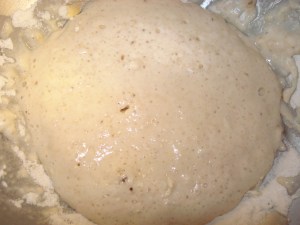
Texture of dough should be supple and elastic, not sticky. Place dough into a large ball in

Dough will rise to double it’s original slice and be supple to the touch

a warm place with bowl covered with plastic wrap and allow it to rise, doubling in size for 30 minutes.

Part Three: The dough may be rolled out singly OR divided into 4 equally sized balls. Cover with a towel and allow to sit for another 5 minutes while preparing  the next steps.

PIZZA STONE in oven or on a grill!

Place a pizza stone directly onto the grill rack or into the oven. Pre-heat grill or oven to 425F or 200 C. Meanwhile, cut dough into 4 equal parts, make small balls and cover with a dry hand towel. Sprinkle Semolina Flour or Corn Meal onto counter and Roll out dough thinly on a counter top. Likewise, sprinkle semolina flour or corn meal onto pizza paddle and then place rolled out dough onto paddle and lastly, add favorite toppings. Using pizza paddle in a gentle rocking movement allow pizza to slide onto preheated pizza stone. Close grill lid and allow to bake on stone for 10 minutes.

Without Pizza Stone

Pre-heat oven to 425 F. Meanwhile, generously grease cookie sheet with 1 tbsp olive oil. Roll out dough and place onto cookie sheet. Add favorite toppings  and place into preheated oven allow to bake for 10 minutes.

Sauce for 4 Pizza Margherita’s

  • 1/2 cup tomato sauce/puree (Ingredients on a bottle or can of Tomato Sauce/Puree will have only Tomatos, salt or citric acid)
  • 1/4 tsp oregano
  • 1/8 tsp salt (a pinch of salt)
  • Top off with Mozzarella
  • 1 tablespoon Extra Virgin Olive Oil
In a bowl, combine tomato sauce/puree, oregano, salt and olive oil. Place 2 tablespoons of sauce onto center of pizza dough and with the backside of the spoon make outward circular motion with the sauce until it is evenly spread, from the center to the edge of the pizza.  Top off with 3-4 thinly sliced fresh Mozzarella or add any other favorite toppings, i.e. mushrooms, olives, anchovies, etc.
  • AFTER PIZZA HAS BAKED, place cooked pizza onto serving plate and drizzle fresh extra virgin olive oil! BUON APPETITO!!!

By: Kimberly Crocker-Scardicchio

Zucchini and Carrot Side Dish

A perfect pairing of two vegetables! Zucchini is high in Vitamin B6,2,1 Vitamin C, A and minerals. While carrots carry the load in carotenoids with recent research also linking critical phytonutrients Falcarinol and Falcarindiol to inhibiting the growth of intestinal and colon cancer cells, making it a power house vegetable! Enjoy this wonderful side dish weekly or daily and see how you can improve your health.

Zucchini and Carrots maybe prepared together or separately. Maybe served over: Rice, Quinoa, Couscous, or Pasta.

Sliced Carrots and Zucchini for saute`

An easy side dish to prepare that takes little time to prepare and full of nutrients. Establish healthier individual standards and enjoy this dish served warm or cold. The recipe can be used for a”Zucchini” or “Carrot” only dish.

Ingredients

  • 2 Garlic Cloves minced
  • 1/4 cup olive oil
  • 3 Carrots, thinly sliced rounds
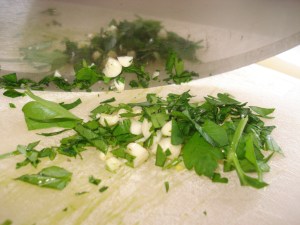
  • Chopped Garlic and Parsley

  • 3 Zucchini, thinly sliced rounds
  • 1/2 tsp salt
  • 1 Tbsp Fresh Parsley chopped

Saute vegetables in pan

Directions:

Place skillet on low-heat, add olive oil and garlic, allow to heat for 4 minutes. Add in sliced carrots and saute` for 4 minutes. Place Zucchini into skillet and add salt. Using a wooden spoon integrate vegetables together, simmering for about 5 minutes.  Add parsley into carrots and zucchini.

By: Kim Crocker-Scardicchio

Research:

Authentic Ragu` Italian Sauce

Old Bari w Homemade Oricchette Pasta

RAGU` is a common dish served in southern Italy for Sunday lunch after morning church services.  Very easy to prepare!

Prep. time 5 minutes!  Cooking time 3-4 hours on low heat.Can be made the day before.

 Serves 4-6 people.

  • 1-2 pounds Roast (1 kilo)
  • 1 medium onion peeled and coarsely chopped
  • ¼ cup Extra Virgin Olive Oil
  • ½ cup red wine
  • Two 28 oz cans tomato sauce (1 ½ L)
  • 1 cup of water.
  • 1/4 cup milk
  • Add salt to taste. 2 tsp. salt
  • 10 leaves fresh  Basil (add ONLY in the last 10 minutes of cooking sauce.) Reserve 6 leaves for presentation of dish.
  • Parmesan Cheese (freshly grated)   

With a sharp knife cut and quarter the roast to accommodate number of people being served and place in a large pan. Add coarsely chopped onion and olive oil. Cover pan and allow to cook for 15 minutes on MEDIUM heat, turning the meat twice with the onions, as to not to burn. 

Add ½ -3/4 cup of red wine, cover the pan and allow to simmer for 5 minutes on LOW heat. 

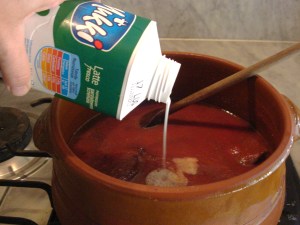
Add tomato sauce,1 cup of water and milk. Prop lid of pan with wooden spoon and allow to simmer on LOW or Warm heat for 3-4 hours turning sauce occasionally (every 20 minutes) as to not to burn the Ragu. 

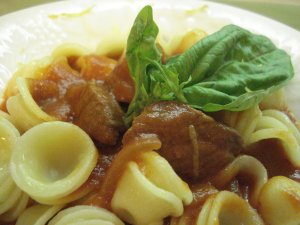
After 3-4 hours of cooking Ragu, Add 10 chopped basil leaves to sauce and remove the Ragu from the heat.  In a separate pan boil water and add your favorite pasta. The Orecchiette (little ears) pasta or Tortellini is commonly used with the Ragu ` Sauce.  This delicious married combination  originated from the city of Bari the beautiful southern region of Puglia, on the breathtaking Adriatic Sea. 

Drain pasta of all water and return pasta to pan.  Add 2-3 ladles full of sauce to pasta and turn in pan .  Spoon out pasta onto dish,  pass with 1 tbsp parmesan cheese, add one ladle of sauce on top of cheese.  Add 1 tsp of cheese to top of sauce and place a fresh basil leave for a beautiful presentation. 

Serve with meat on side.  Click on Waldorf Salad to complete this dinner!

By Kimberly Crocker

Old City of Bari and Homemade Pasta

Read Your Palm, Determine Your Diet

Open hand, read your palm to know your serving size of meat.

Read your own palm and know your personal dietary needs. An open flat palm (don’t include the fingers) shows the size of meat, poultry or fish that YOU should consume. The thickness and the length of the palm perfectly identifies your personal protein needs. While an individual’s fist size (closed hand) can give you your own serving size for fruit and vegetables.

Your fist size determines your own single serving.

Clear the confusion over serving size, don’t let it upset your apple cart and ruin your diet! By better understanding what a serving size may look like, consider these unique tips to trigger your memory the next time your prepare a meal, or go out to eat a restaurant. Ones body can tell an individual how they must eat to meet their own individual needs. Remember, in order to not over eat, drink (245 ml) 1 glass of water before your meal and another during the meal.

Serving Sizes: Use the list below to measure foods and serving sizes. A serving size means the size of food after it is cooked or prepared.

  • 1 teaspoon (tsp) is about the size of the tip of your little finger (from the last crease)
  • 1 tablespoon (Tbsp) is about the size of the tip of your thumb (from the last crease).
  • 2 tablespoons (Tbsp) is about the size of a large walnut.
  • One ounce of hard cheese is about a 1 inch cube.
  • 3 ounces of cooked meat, fish, or poultry is about the size of a deck of cards.
  • 1 ounce of cooked meat, fish, or poultry is about 1/4 cup (c).
  • 1/2 cup of fruit or vegetables is about half of a fist (A serving of cooked vegetables is 1/2 cup (1/2 handful) or 1 cup (1 handful) raw.)
  • 1 cup of food is the size of a fist, or 8 fluid ounces of liquid.
  • 1-1/2 cup (12 fluid ounces) of liquid is the size of 1 soda-pop can.
  • 1 pint or 2 cups (16 fluid ounces) of liquid is the size of 1-1/3 soda-pop cans.

The American Dietetic Association counsels that individuals maintain a healthy lifestyle by
including the following into their dietary intake:

  • 4 Serving Fruits
  • 5 Servings Vegetables
  • 2 Servings of Milk
  • 2 Servings of Protein
  • 2 Servings of Healthy Fat (2 Tbsp of Extra Virgin Olive or Canola Oil)
  • 6-11 Servings of Bread (Determined by body size; men eat more bread servings, while women eat less.)
Be smart and plan each meal! When choosing foods, aim for a daily total of 25-38 grams of fiber that will come from Vegetable, Fruit and Multi-Grains.
By: Kimberly Crocker- Scardicchio

References