Calculate Cholesterol, Choose TLC Diet to Menu Plan

Being informed and understanding what cholesterol is will provide stronger knowledge of individual “Specimen Information”, which should be requested from your Doctor after having blood drawn. Compare your numbers to the information listed below,  choose your foods wisely to improve your daily nutritional intake, and cleanse your body, optimizing it’s overall function in keeping you healthy.

Cholesterol is a fat,  lipid, or a sterol, from which hormones are made. It is a waxy substance that resembles the very fine scrapings of a whitish-yellow candle. Cholesterol flows through your body via your bloodstream, lipids are oil-based and blood is water-based, they don’t mix. If cholesterol were dumped into your bloodstream, it would congeal into unusable globs.

The fat in these particles are made up of cholesterol, triglycerides and a phospholipid, which helps make the whole particle stick together. Triglycerides are a particular type of fat that have three fatty acids attached to an alcohol called glycerol, composed of 90 percent of the fat in the food you eat. The body needs triglycerides for energy, but as with cholesterol, too much is bad for the arteries and the heart.

  • Total Cholesterol Reference Range: 125-200 mg/dl     
  • HDL Cholesterol Reference Range: 40-60 mg/dl 
  • TriglyceridesReference Range:  <150mg/dl                   
  • Direct LDL Cholesterol Reference Range: 100 – 129 mg/dl
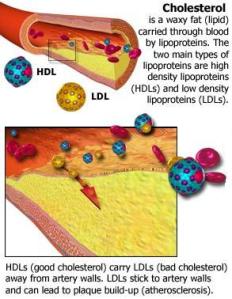
                                                                                                                                                                                                               

Healthy Cholesterol Levels, (HDL) should be greater than 50-60 mg/dl.   HDL is a cholestrol that works within the arteries to reduce accumulation of plaque, that can lead to artherosclerosis, in turn, reducing your risk for heart disease. HDL is monitored to ensure there is enough of it to fight off the plaque build up within the arteries.

 “LDL cholesterol”, explained by Harvard University“in most people, (60-70 % of cholesterol) is carried in LDL particles, which act as ferries, taking cholesterol to the parts of the body that need it. Unfortunately, if you have too much LDL in the bloodstream, it deposits the cholesterol into the arteries, which can cause blockages and lead to heart attacks. The good news is that the amount of LDL in your blood-stream is related to the amount of saturated fat and cholesterol you eat. So, most people can decrease their LDL if they follow a reduced-fat diet.”

VLDL, stated by the “Clinical Reference Laboratory”, expressed as: “VLDL is a major carrier of triglyceride (60 -70% triglyceride 10-15% cholesterol). Circulating fatty acids are converted by the liver to form triglycerides.” Dr. Ginsberg of Columbia university simplifies the definition, “Very-Low Density Lipids are complexes of lipids and proteins assembled in the liver in response to nutrients and hormones. When VLDL are secreted, they carry almost all of the triglyceride in the blood-stream (they are about 85% triglycerides themselves), transporting triglycerides from the liver. When we are overweight, insulin resistant, or have diabetes, our livers secrete more VLDL with more triglycerides on every VLDL particle”.

People have varying degrees of success in lowering their cholesterol by changing their diets.  Meal Plan changes and Exercise both contribute to  lowering cholesterol and are highly recommended before pharmaceuticals are introduced. High cholesterol due to dietary intake of high saturated  foods (anything with animal fat) could be lowered by 5% to 20% with nutritional changes. The Therapeutic Lifestyle Change (TLC) Diet is recommended by the National Cholesterol Education Program of the U.S. National Institutes of Health. 

Calculating total cholesterol helps to put the pieces of the whole together.   The math equation for calculating total cholesterol is:

Total Cholesterol Formula  (TC) = LDL + HDL + (Triglycerides/5)

  • Sample lipid panel
  • Cholesterol, Total=195
  • HDL Cholesterol=55
  • Triglycerides = 100  (100/5=20)
  • Direct LDL Cholesterol=120

How Total Cholesterol is calculated using the sample numbers listed above.

  • example: (LDL) 120+ (HDL) 55 + 20= 195 (TC) Total Cholesterol

Calculating:  VLDL=Triglycerides/5

  • Triglycerides=100
  • example: 100/5=20 (VLDL)
  • Reference Range for VLDL is 5-40 mg/dl

Calculate Cholesterol Ratio

  • Total Cholesterol (mg/dl) / HDL Cholesterol (mg/dl)
  • Example: Total Cholesterol 200 mg/dl/ 50 mg/dl  HDL Cholesterol = 4.1  According to the American Heart Association is to keep your cholesterol ratio at 5 to 1 or lower.
  • Ideal ratio will be 3.5 to 1. Higher cholesterol ratio indicates a risk of heart disease, a lower ratio indicates a reduced risk of heart disease.


Various foods, beverages and spices are known for reducing, or interfering with bad cholesterol (LDL) and carrying it out of the body. Choose a variety of foods from the following lists including them at all your meals.

  •  Fruits and Vegetables (totaling 9 per day)
  • Teas
  • Extra Virgin Olive Oil
  • Cinnamon1-4g (1/3 tsp – 1 1/2 tsp a day)
  • Ginger (250 mcg/day capsule form)
  •  Honey 3 1/2 tablespoons / day

Reduce the saturated fat in your diet 

  1. Eat fish 3-4 times a week and benefit from Omega 3!
  2. Limit the amount of meat and milk products.
  3. Choose low-fat products from various food groups.
  4. Replace butter, a saturated fat with: Extra Virgin Olive, Canola, or Peanut oils.  7% of your daily calories should come from saturated fat (200 mg)   with 25% to 35% of daily calories  from unsaturated fat. 
  5.  Your diet should include calories to maintain your desired weight and avoid gaining weight.

Fluids are equally important to a successful diet.  Add 1-2 glasses of water with 1/2 to 1 whole lemon each day. Drink 1-2 cups of Oolong tea each day. Oolong tea burns over 157% more fat than Green Tea and is a popular tea designed to accelerate weight loss. 

TLC Diet is recommended by Doctors as a path for reducing high cholesterol.  Calories/day  1100 – 1695

Lean meat, poultry, fish, dry legumes Choose 5 ounces (140 g)  per day  

  • Anchovies, Mackeral, Sardines, Salmon,
  • Substitute 1/4 cup tofu, or 1/2 cup dry beans or peas for 1 ounce of meat or fish.
  • 2 tablespoons (1 oz) nuts (Almonds, Walnuts, Hazelnuts, Peanuts Soynuts) or seeds
  • Eggs, 2 yolks per week, 1 whole egg. Egg whites or substitutes are okay to eat.
  • Lean Meat. 3 0z. 165 calories, 0 g carbohydrate, 21 g protein, 9 g fat

Low-fat milk products.  Choose 2 per day     

  • 2 to 3 per day
  • 1 cup nonfat or 1% milk
  • 1 cup nonfat or low-fat yogurt
  • 1 ounce fat-free or low-fat cheese
  • Each serving. 80-110 calories, 12 g carbohydrate, 8 g protein, 0-3 g fat

Fruits.  Choose 4-5 per day the selection is endless!    

  • Apple, Apricots, Berries, Banana, Grapes, Melons, Orange, Pear, Plums, Prunes
  • Each serving.  60 calories, 15 g carbohydrate, 0 g protein, 0 g fat

Various Vegetables!  Choose 5-7 per day          

  • Artichokes, Avocado, Peppers, Zucchini, Cucumbers, Mushrooms,Eggplants, Asparagus, Legumes, Broccoli.
  • 1/2 cup cooked (season with garlic parsley and oil), Grilled, or Raw vegetables
  • Each serving.  25 calories, 5 g carbohydrate, 2 g protein, 0 g fat
    1 cup raw thick green leafy greens

Whole grains for bread, cereals, pasta, rice .  Choose 4-6 servings per day.

  •  Whole Grains, Choose Aunt Millies breads.
  • 1 slice whole grain bread
  • 1/2 wheat or multi-grain bagel, or English muffin
  • 1 ounce cold cereal (Bran)
  • Oatmeal for breakfast. (Quaker Oatmeal steel cut. Avoid 1 minute oatmeal)
  • 1/2 cup cooked whole grain pasta, rice, noodles, or other grains
  • Each serving. 80 calories, 15 g carbohydrate, 3 g protein, 1-3 g fat

Fat and oils.  Choose 2-3 servings per day

  • Each serving.  45 calories, 0 g carbohydrate, 0 g protein, 5 g fat.
    No Trans Fat (hydrogenated oils)
    1 teaspoon monounsaturated oil, such as Canola, Corn, EVOO, or Peanut
    1 tablespoon salad dressing (vinagrette)
    1 tbsp MCT Oil

By:  K. Crocker

Literature Research

  1.  Diet Low Sodium Meal Plan
  2. VLDL http://www.crlcorp.com/testDetails.cfm?facilityID=TLS&testID=510
  3. VLDL Dr. Ginsberg  http://www.medscape.org/viewarticle/569664av
  4. LDL Harvard University  http://www.health.harvard.edu/newsweek/Understanding_Cholesterol.htm
  5. Ginger reduces LDL Cholesterol  http://www.ncbi.nlm.nih.gov/pubmed?term=ginger%20reduces%20ldl
  6. Cinnamon reduces LDL Cholesterol http://www.ncbi.nlm.nih.gov/pubmed/14633804
  7. Honey Reduces Cholesterol http://www.ncbi.nlm.nih.gov/pubmed/18454257
  8. Calculate Cholesterol Ratio  http://www.mayoclinic.com/health/cholesterol-ratio/AN01761

Attention to Reducing your Cholesterol

Reduce Cholesterol and Blood Pressure

New Years with a fresh new start to keep you on your toes and modeling ideal habits for those you love.  Follow these basic steps to reduce your cholesterol and blood pressure, impacting and leading to a stronger lifestyle.

In brief, it’s important to know very basic facts.

  1. The body’s liver makes its own cholesterol everyday.  Cholesterol is a key factor the functionability of our hormones and to the elasticity of our veins and arteries.
  2. HDL is a healthy cholesterol needed to keep our hormones, organs, muscles, veins and arteries operating properly.
  3. LDL is an unhealthy cholesterol when it becomes oxidized.
  4. Reduce Stressful Lifestyle:  walk away from or limit interaction with stress triggers, avoid comfort foods that can contribute to increasing cholesterol. (salty & fried foods, dairy products, red meats)                                                                                                                              

Knowledge to influence better habits

Oxidation of LDL is due to free radicals floating around in our body which are  O+ broken off from degenerating protein called homocysteine. The positively charged oxygen then attaches itself to LDL cholesterol and plaque begins to form in your arteries and veins. Hence forth, why anti-oxidants from fruit and vegetables need to be a part of ones daily intake, to clean up the free radicals.

Check the grocery cart before before bringing home the bacon! LDL cholesterol is established through nutrition and found in hydrogenated fats and animal fat.    Hydrogenated fats can be found in margarine, shortening, cookies, and oil-frying. By switching grocery purchases of high caloric fats for fresh seasonal fruits, you are already stepping up!

It’s easy to do!  Reduce consumption of animal fats, or saturated fats; found in milk, butter, cheese, ice cream, meats and pork.  Although we need a certain amount of meats and fats  they should be consumed in small amounts.  A meat serving is 3-4 ounce (84-112 g) servings consumed once or twice a day, while a fat serving is 2 Tbsp of oil per day

3 Effective Steps to Increase HDL

  1. Walk 30-60 minutes five times a week for a total of 2 1/2-5 hours per week.  Walking twice a day for 20-30 minutes each time will increase your metabolism, strengthen bones, muscles and keep your heart pumping…increasing the HDL cholesterol, which removes LDL cholesterol from your arteries.
  2. Consume foods that increase HDL levels:  Omega-3 rish foods: Extra Virgin Olive Oil, Canola, Walnuts, Almonds, Fish and Fiber.  Fruit and Vegetables , total of 9 1/2 cup servings a day.  Please refer to:  Daily Serving Guidelines.
  3. Beverages that assist in increasing HDL levels: Cleanse your body with lemon water or green/black/white tea throughout the day.  Wine and alcohol in moderation; 1 glass for a woman, 2 glasses for a man.
    Reducing cholesterol levels puts into place the first step to reducing blood pressure. It is important to note that attention to reducing salt levels and increasing potassium intake will impact a decreased blood pressure as well. By establishing a plan to  healthier eating and daily exercise, you will feel stronger sooner than expected!

By: K. Crocker-Scardicchio

References

Heat Up & Cool Down! Foods to Add & Remove in Diet

Feeling ‘overheated’  emotionally or physically? Lack of daily movement or what you eat can both contribute to the sense of being warmer than usual.   Addressing the  behaviors that  lead to emotions of anger, depression and stress, all result in negatively heating the body. Headaches, sleepless nights, skin flare-ups, irritability are all examples of how the body heats up as a direct response to stress. Continuing on a declining path will create physical heath conditions: heart attack, stroke, cancer, etc.

Best Exercise for Managing Stress
Walking, swimming, bicycling, yoga and golf are good examples that contribute to relieving or cooling down an individual so that emotional stress is controlled through physical activity. Exercise  increases the endorphins within the brain so  the blood pumping, energy is restored and you will feel more focused.  It can be as simple as a 30 minutes of movement per day!

How Stress Affects Hormones
Choosing to stay on an unenthusiastic  cycle alternates both stress hormones adrenaline and cortisol and how they function in the body. Adrenaline and cortisol when adversely effected influence changes in our blood pressure and cholesterol levels, stimulating the ghrelin hormone (hunger) that promotes an excessive appetite and depresses the leptin hormone that signals satiety in the stomach!  Appetites have now been re-defined.

Foods that Promote Over-Eating
Avoid spices, condiments, drinks , and certain foods that promote over eating when facing stress: fried, greasy or oily foods, margarine, black pepper, chilies, cinnamon, nutmeg, ginger, garlic, onion, salad dressings, rosemary, white and brown sugar,  white flour, wine, beer, coffee.
Reduce amounts of:  salt, red meat, chicken (4 ounces 2-3 times a week),  cheese (1 oz q/day).  Poor quality fats clog arteries and lead  to heart disease. Calcium and magnesium uptake interference  can be altered by an excess of certain meats spices and drinks, having a negative effect on calming and cooling the body. A deficiency of magnesium leads to anxiety and hyperness.

Dietary Solution to Control Stress 
Fats in the diet must be high quality in order to maintain healthy organs and vascular system, use: fish oils, extra virgin olive, grape seed, flax seed , almond oils. Introduce foods that promote calcium, magnesium absorption, anti-oxidants and polyphenols.
Best food preparation: Grilled, Braised, lightly boiled (7 minutes), steamed.
Consume raw vegetables, fruits (remove citrus fruits if they create digestive problems), berries, nuts, whole grains, yogurt and seafood. Include salads, melons, cucumbers and bitter greens (broccoli, arugula, celery dandelion, basil, parsley, cilantro) which are full of water and needed for calming and cooling the body. Eat plants that are in season for optimal nutrition. Consider pomegranates as way to intake resveratrol protein which helps raise HDL cholesterol and reduce red wine intake. Add decaffeinated black, green and white teas as a way to hydrate and include anti-oxidants and reduce caffeine.

Daily and Weekly Diet
Consuming breakfast is critical for energy and initiating the metabolism and should not be skipped. 5-6 small meals are necessary for proper maintenance of a healthy individual, light evening meals eaten 4 hours before bedtime to optimize a restful sleep.  Daily intake of  nutrition should include: 4 servings of fruit, 5 servings of vegetables, 1 ounce (28 g) cheese,  3-4 weekly servings fish, 2 weekly servings meat, multi-grain breads, pasta rice, 1-2 servings soy or lowfat milk, 6 cups water (250 ml).

By incorporating a healthy diet and managing stress through exercise hormonal balance can be achieved. While the initial steps can be put into place by you, communicate any dietary or physical activity changes to your doctor so that your overall health can be observed and guided as needed.

By: Kim Crocker

Cannoli Siciliani

Delicious crunchy pastry with sweetened ricotta

Delicious crunchy pastry with sweetened ricotta

The most popular Sicilian Pastry Dessert causes one to salivate upon the mention of “Cannoli”.  Cannoli or “little tubes” has an outward crunch and the sweetened ricotta filling that leaves one wanting for more. The dough takes minutes to make  and the process of rolling out and frying the dough beckons anyone within the vicinity of your kitchen to come in and see what’s cooking. Well worth it’s value in a single bite, set aside 30 minutes and enjoy! Buon Appetito.

Makes 10-12 Cannoli Shells

Pastry Ingredients (combine in order):
1 cup (224 g) flour
1 1/2 tablespoons olive oil
1/4 teaspoon cinnamon
1 tablespoons sugar
1/8 cup wine (i.e. Sweet Marsala, Spumante or White Wine)
1 egg slightly beaten
Vegetable oil for frying cannoli

Chocolate Filling:  3/4 cup Semi- sweet chocolate.

Ricotta Filling
1 1/2 cup Ricotta whole milk
2/3 cup sugar
1/2 tsp vanilla
1/2 cup candied fruit, or chocolate chips

Cut Olive oil into flour until mixture resemble coarse crumbs. Fold in sugar and cinnamon. Add slightly beaten egg working into the dry ingredients. Gradually, add wine. Mix by hand until pastry holds together.  Form a ball, cover with plastic wrap and let rest in the refrigerator for 1 hour.

Start to heat vegetable oil in pan or fryer to about 375F

Divide dough into quarters and keep covered as to not lose moisture.

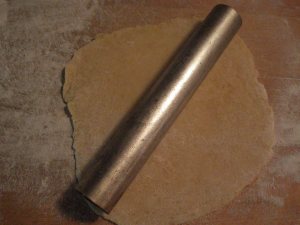
Roll out cannoli doughOn a lightly floured surface, roll out dough as thin as possible (about the thickness of a dime.) Use a circular cookie cutter  to cut out shape of dough.  Loosely place dough around cannoli form and pinch to seal closing.

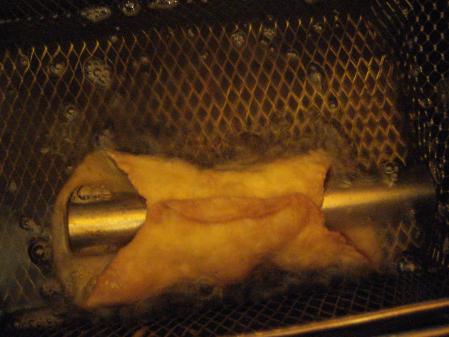
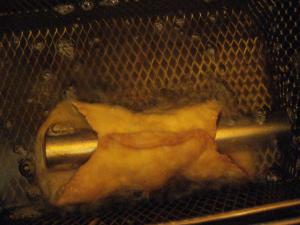
Allow to fry until blistered and the color is golden about 2 minutes.  Drain on

Deep fry Cannoli in 375 F oil.

Deep fry Cannoli in 375 F oil.

paper towels. Let cannoli cool before removing forms.  (Cannoli shells can be stored in a tin with paper towels for 2 months.)

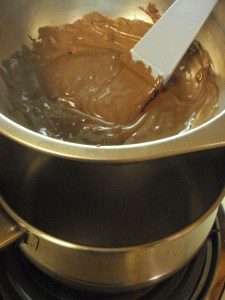
Double boiler for melting chocolateCreate a double boiler by filling one sauce pan 1/2 full of water. Place a second pan on top of pan filled with water (making sure that the water does not touch the top pan) and add chocolate to top pan. Place on medium high heat. Stir chocolate with wooden spoon or pastry brush. When melted paint the inside of the cannoli with chocolate and layer onto a plate. Place into refrigerator and allow chocolate to harden inside cannoli. Once hardened, remove from refrigerator and with a teaspoon add ricotta filling.

FILLING               DSC01266

Place ricotta in a sieve and allow water to drain while working on cannoli shells.
Mix all ingredients well. Refrigerate until time to fill cannoli shells. With a teaspoon fill shells just before serving.
Sprinkle filled Cannoli shells and with powdered sugar.

Holiday Turkey with Cranberry & Rosemary Stuffing

Roasted Turkey with Oranges & Apples

Benjamin Franklin thought that the Turkey should be the country’s state bird and in many ways he got his wish. World wide, the most recognized symbol associated with the American holiday to celebrate Thanksgiving is the beloved bird. The holiday meal in that of itself, symbolizes a portion of the history: death and abundance, family gatherings and compromises. While the beauty of the celebration is that we set a moment aside to be thankful.

PLANNING DINNER  Adults with a healthy appetite generally eat more and kids generally eat less. To plan for purchasing a turkey allow approximately 1 lb. (500 grams) of turkey per person.

ROASTING TIME  Take into consideration the amount of time needed before a sit down dinner. Recommended Roasting  at 350 F  (177 C) will allow the turkey to cook at 20 minutes per pound.  A lower temperature of 325 F (163 C), allows the turkey to bake at 30 minutes per pound.  In other words, a 15 pound turkey would bake for 5 hours at 350 F, or 7  1/2 hours at 325 F.

This recipe layers in various ways to keep the moisture in the turkey so that it will not dry out. Begin by using a V-rack in your roasting pan OR create your own V-rack by layering the pan with fruit and set the turkey on a bed of orange and apple slices. Once the fat from the turkey melts, it falls to the bottom of the roasting pan. When that happens, the bottom quarter of the bird does not roast–it braises in its own juices.

The recipe has been written for a mid-size bird. Increase or decrease ingredients according to the size of the bird that you have chosen, carefully paying attention to the cook time chart below.

Approximate Roasting Times for Stuffed Turkey. Bake Temp. 350 F (177 C)
Turkey Weight Hours
6 to 8 pounds 2 hrs to 2 hrs 40 mins
8 to 12 pounds 2 hrs 40 mins to 4 hours
12 to 16 pounds 4 to 5 hrs 20 mins
16 to 20 pounds 5 hrs 20 mins to 6 hrs 40 mins
20 to 24 pounds 6 hrs 40 mins to 8 hours
Roasting Times for Unstuffed Turkey (hours=hrs  & minutes=mins)
Turkey Weight Hours
6 to 8 pounds 2 to 2 hours 40 minutes
8 to 12 pounds 2 hrs. 40 mins to 4 hours
12 to 16 pounds 4 to 5 hours 20 minutes
16 to 20 pounds 5 hrs 20 mins to 6 hrs 40 mins
20 to 24 pounds 6 hrs 40 mins to 8 hours

For more information on Everything Turkey click here http://www.butterball.com
INGREDIENTS

  • 12 lb. turkey (allow 4 hours for cooking)
  • 2 apples and 2 oranges (helps to promote moisture while baking in oven)
  • 2 Tbsp butter OR 12 bacon strips
  • 1 Tbsp rosemary
  • 2 tsp thyme
  • 2 tsp sage
  • 1 1/2  to 2 tbsp salt
  • 2 cups water

DIRECTIONS
Prepare Cranberry and Rosemary Stuffing, set aside. Preheat oven to 400 F degrees. Remove the giblets and neck if they are encased in a plastic bay within the back side of the turkey. Rinse and pat the turkey dry. Cut the oranges and apples into 1/4’s. Place 1 orange quarter and 1 apple quarter into the bird and then fill with a portion of the stuffing. Lay the remainder fruits under the bird. The water from the fruit provides moisture to the bird while cooking.  In a small bowl, combine rosemary, thyme, sage, salt and oil. Rub the seasonings under the skin on top of of the turkey and over the entire turkey. Layer bacon slices side by side all over the turkey this is so the meat stays hydrated: OR use only butter in place of bacon rubbing it over the bird. If the legs are not secured with a wire, tie them together with kitchen string. Place the turkey on a V-rack in a roasting pan with the meatier side (breast side up) and the less meatier side down setting on top of presliced fruits. Cover with aluminum foil creating a tent on top so that moisture circulates with in the pan and around the turkey.

For 12 pound turkey allow 4 hours baking time. Reduce oven temperature to 350 degrees. After one hour, baste the turkey with it’s own juices, using a baster or gravy ladle. Repeat at the second and third hour. After third basting, remove aluminum foil. Baste after 30 minutes.  Continue cooking the turkey until an internal temperature of stuffing  is 163 F  degrees, or insert the thermometer into the thick thigh  with out touching the bone, temperature should be 177 F.  Also look for other indications of doneness: loose joints and juices running clear. If turkey skin begins to turn dark brown before the internal temperature is met,baste once more and cover the turkey with foil and continue to roast.
Makes 15 (4 ounce) servings; various amounts of light and dark meat

Cranberry Stuffing  

Cranberry Rosemary Stuffing

  • 1/2 cup celery
  • 1  onion chopped
  • 1 garlic clove minced
  • 3 Tbsp butter, or Olive Oil
  • 1/2 tablespoon chopped fresh sage or 1/2 tsp dried sage
  • 1 1/2 teaspoon chopped rosemary or 1/2 tsp dried rosemary
  • 4 cups cubed toasted bread, (OR 2 cups cubed toasted bread  and 2 cups seasoned bread crumbs)
  • 1-1 1/2 cups Dried Cranberries 
  • 1/3 cup chopped walnuts (optional)
  • 3/4 tsp salt
  • pepper to taste
  • 1 1/2 cup warm water with a bullion cube dissolved (or pre-made broth)

Over medium heat, saute` in 3 Tbsp olive oil onion, garlic and celery for 5 minutes. In a separate pan, over medium heat add water, bullion cube and milk, bring to a slow boil, about 7 minutes.  In a bowl, assemble herbs, bread crumbs, cranberries, walnuts, salt and pepper. Take saute mixture and add to bread crumbs, stir with spoon. Slowly add the broth to the stuffing ingredients with wooden spoon until bread crumbs are moistened, but don’t become soggy. Place into an oven proof dish and bake in oven on 350 F for 20 minutes. May place a portion of stuffing in cavity of turkey, stuffing should reach 163 F inside turkey to be done.

Number of Servings: 15