3.5 Times Better vs Average Diet….YOUR SUCCESS!

3.5 TIMES BETTER THAN THE AVERAGE DIET!!!

Those are OUR numbers… Your Trust Means Your Success!   THANK YOU to 100% of my dietary consults. CONGRATULATIONS to the 70% who successfully completed 3 months to obtain a new Lifestyle!

A recent study released by a UK food company challenged me to address the program that I have set forth for my dietary consults and I was pleased to see the impact of the Mediterranean Lifestyle.  (UK & USA have similar dietary habits so the relevancy will produce more research in the states.)

Promoting longevity and a healthier lifestyle for others is paramount in my approach to coaching others to nurturing a long term habit, while avoiding the pitfall of a quick tip to a short term weight loss.  Slow and steady are the results that individual notes weeks, months, and years later as maintenance is easy to do, because adaptation to nutritional intake becomes the new norm. http://eatknowhow.com/personal-consultation/

The individualized Mediterranean Lifestyle that I set forth for my clients is tailored for that person’s dietary needs, and it is performing at a FANTASTIC rate compared to other “diets”. We are doing 3.5 TIMES better than those who pursue other types of diets!

A UK food company surveyed dieters, finding 2 indivduals out of 5 quit within the first 7 days! 1 person out of 5 complete one month, the number does not change in reaching 3 months of practicing the new diet. In conclusion, only 20% of individuals keep their commitment to an improved lifestyle.

The cooking classes provide a support system to the “Lifestyle” that is set forth for dietary consults and for those who want to improve on familial / individual nutritional habits.

Fall classes are back in session please check the following link to so that you may set up attendance or for open or private sessions.  http://eatknowhow.com/classes/

Grateful for your trust,
~Kim

Kimberly Crocker-Scardicchio BASC DTR

REFERENCES

USA Article Published September 19, 2013: Cynthia Sass MPH RD
Original UK Article September 16, 2013:

Mediterranean Diet Low Sodium Meal Plan

The Mediterranean Diet is high in fruits, vegetables, and lean meats and seafood. The common thread is an abundance of Vitamin E found in many meals. Lastly, socialize and exercise with family and friends to make this a complete Lifestyle Change!

The following sample daily menu is a plan that incorporates both the Mediterranean and “DASH” diets, with the latter focused on reduced sodium intake.  By structuring meals throughout the week improved health will soon be noticed. One change that is noticeable with listed meals is that the calories are loaded in the morning and afternoon, the calories then taper off in the evening.

A key element to the success of this diet is reduced low salt intake in the food preparation. Fluids are equally important for a healthy lifestyle, add 6-8 glasses of water to your daily routine, choosing to squeeze the contents of 1/2 -1 whole lemon to a single  glass of water each day.

Please contact the listed telephone number if you are interested in more information or would like to establish a consultation. kimberlyscardicchio@yahoo.com

Breakfast

  • 1 slice whole wheat toast (I choose Aunt Millies “5 Grain Bread Light”, 2.5 grams fiber/slice.)
  • 1 tbsp Raspberry Jelly
  • Oatmeal (preferably 1 or 5 minute stove top)
  • 1 orange
  • (1.5  breads, 1 grain, 1 fruit)
  • 2 glasses of water (one glass of water with the juice squeezed from a fresh lemon.)

1 glass of water

10:30 am Snack
Chop and Combine

  • 1 Tbsp unsalted nuts  or sunflower seeds
  • 1 (choose 1) apple, plum, pear, peach
  • 1 four ounce low fat yogurt
  • 1 glass water
  • (1 protein, 1 fruit,  1 dairy)

Lunch

  • 2-3 oz fillet of fish, lean meat or poultry with 1/4 tsp salt or Mrs. Dash salt substitute
  • 1 c. ea. sliced carrots / zucchini (sautee 15 min’s with 1/8 c. olive oil. Add minced garlic, parsley)
  • diced 1 potato, 1 pepper, 1 peeled onion season with rosemary, thyme, 1/4 tsp salt, 1/8 c. oil. (Heat on med. for 20 minutes.)
  • 1 glass of wine
  • 1/2 cup grapes
  • (3 vegetable, 1 fruit, 1 protein,  1 fat)
  • 1 glass of water

2:00 pm   Snack

  • 1 Banana, or 1/4 cup berries, or 7 prunes
  • 1 glass of water
  • (1 fruit)

1 glass of water

Dinner

  • 1 cup lettuce
  • 1/2 cup tomato
  • 1 cup VEGETABLE: avocado, beans, sweet potato, or baked potato
  • 4 ounces of fish or chicken
  • 1 ounce of low fat cheese
  • 1-2 tsp Olive Oil and Vinegar
  • Glass of water with lemon
  • 1 Fruit of choice
  • (3 vegetable, 1 fat, 1 dairy, 1 protein, 1 fruit)

2 glasses of  water before bed

Hyper & Hypothyroidism and Nutritional Therapy

An ultra sound of the thyroid gland

Common expressions:   “I am so tired” and  “I feel cold”.  We can thank the small gland that’s wrapped around the trachea, our thyroid for various sensations. This small butterfly organ has 3 principle functions: cellular differentiation, growth and metabolism. Two key hormones (thyroxine) promotes the body’s growth & development and with help from the parathyroid gland, there’s bone formation and control of calcium in the blood (hormone calcitonin). The small double lobed gland claims to fame are also attributed to: sleep patterns, weight maintenance, moods, immune system, muscle agility and heart rate, etc.                                                                                     

While the thyroid is busy deciding how it will control the bodies energy, there may be an over production of the thyroid hormone (autoimmune disease or Graves Disease) it’s called Hyperthyroidism. Other causes linked to hyperthyroidism may be attributed to inflammation, nodules or tumors on the thyroid. You may notice an increased heat rate with exercise and excessive sweating with or without exercise.

There maybe a time  in it’s lifespan that the thyroid hormone output is reduced, called Hypothyroidism. Some of the initial symptoms are: weight gain with no change in diet or exercise, depression, and exhaustion.  The negative effects of untreated hypothyroidism are: increased cholesterol levels, strokes, cardio vascular disease and the immune system that turns on the body first attacking the thyroid itself (Hashimoto Disease). THE GOOD NEWS is that hypothyroidism is easily treated through daily medication.

Typical reference ranges for normal thyroids

Test From To Units
TSH 0.4 4.5 mU/L (milliunits per litre)
FT4 9.0 25.0 pmol/L (picomoles per litre)
FT3 3.5 7.8 pmol/L (picomoles per litre)

These ranges are only a guide. The reference range for FT4 in particular does currently vary between methods and so any ‘typical’ reference range quoted will be subject to method and local interpretation

Test results outside the reference range

  • high SH level with a low FT4 level: Hypothyroidism (under-active thyroid)
  • low TSH level with a high FT4 level and a high FT3 level: Hyperthyroidism (over-active thyroid)
  • Abnormal TSH levels together with normal FT4 levels indicate you may be at risk of developing a thyroid disorder
  • A low TSH levels together with a low FT4 levels can indicate a disorder of the pituitary gland

SYMPTOMS OF MALFUNCTIONING THYROID  can be noticed at any age and can even be misinterpreted as signs of aging;

Diagnosis. After a blood diagnosis, your doctor will prescribe a medication that you will take every morning, so that your thyroid wakes up in the morning with you, one hour after taking the medication you may eat. Within 2 weeks to 2 months, most symptoms will go away and your energy will return. The medication is something that you will take the rest or your life, a small price to pay for remaining healthy. “As of February 2010, at most laboratories in the U.S., the official “normal” reference range for the Thyroid Stimulating Hormone (TSH) blood test runs from approximately .5 to 4.5/5.0 according to the American Association of Clinical Endocrinologists.
MEDICATION INTAKE  will make a difference in homeostasis. The time of day that you take your “Synthroid” can influence how you feel, level of alertness, how you sleep and stability in weight. Studies performed show that medication taken at bedtime allows for proper absorption of the medication, without interference from nutritional minerals that could otherwise alter it’s function. Changing the time of day that you take your medication should be discussed with your Doctor.  For observation purposes they may have the switch made after a blood draw in order to better control the variables and achieve accurate documentation of the TSH (thyroid stimulating hormone).

NUTRIENTS

There are several nutrients that play key roles in the thyroid gland and the thyroid hormone function: zinc, copper, iodine, selenium and omega-3 fats. A multi-vitamin along with eating foods high in these minerals, is essential for normal thyroid hormone production and metabolism.

Dietary sources of zinc include: seafood, beef, oatmeal, chicken, liver, spinach, nuts and seeds.

Copper is mainly found in liver and other organ meats, eggs, yeast, beans, nuts and seeds.

Iodine is also an important building block for thyroid hormone.  Nutritional sources of iodine include sea fish, sea vegetables (kelp, dulse, hijiki, nori and kombu) and iodized salt.  Iodine is such a key component of thyroid health. 

FOODS TO LIMIT.  A high LDL Cholesterol number accompanied by a high Triglyceride number is linked to Insulin resistance, often noted with hypothyroidism. Foods that should be eliminated: white flour, white sugar, rice, pasta, bread, corn, potatoes (all types), cereal, desserts, dairy products, meat, citrus fruits. Caffeine, calcium should be consumed in limited amounts.   Goitrogen foods are also able to block iodine, therefore, utilization of these foods should be limited. They include:turnips, cabbage, broccoli, cauliflower, mustard, cassava root, soybeans, peanuts, pine nuts and millet, (peaches and strawberries may also interfere). Cooking, however, usually inactivates goitrogens.

BEST FOODS to promote metabolism: Sour fruits (kiwi, juice of fresh lemon), pears, apples, plums, fish, turkey, chicken, legumes and vegetables.

Selenium.  One of the best natural sources of selenium is Brazil Nuts. Selenium is an important mineral that contributes to the health of the thyroid. 1 ounce of nuts a day will benefit the small gland.

Omega-3 fatty acids will also contribute to normal thyroid function, which can be found in fish and fish oils, as well as vitamin A, which improves thyroid receptor binding and thyroid hormone activity.

Tyrosine, an amino acid and a precursor for making thyroid hormoneA deficiency of tyrosine or low protein diets can contribute to low thyroid function.  Check with your doctor if supplementation at a dose of 500-1,500 milligrams (mg) daily, which has therapeutic benefits, is needed.

Exercise. Daily exercise stimulates thyroid gland function and increases tissue sensitivity to thyroid hormone.  Try walking, biking, dancing at least 20 minutes a day.  However, walking 30 minutes twice a day, seems to encourage both the fuctionability of the thyroid and weight loss versus weight gain normally associated with hypothyroidism. While with hyperthyroidism an exercise regimen should be advised by a doctor in order to monitor a fast heart rate.

By Kimberly Crocker

References

Kidney Disease Low Phosphorus Diet

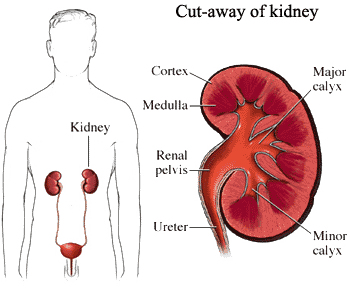
We are all provided with two equal fist sized organs, found in our lower back on either side of the spine just above the waist called Kidneys. Renal physiology is the study of kidney function, while nephrology is a medical specialty that focuses on kidney disease.

In brief, the kidneys perform multiple functions to sustain the life of the body, cleanse the body by removing waste and excess fluid through urine, provide a balance of water, salt, potassium, phosphorus and produce an active form of Vitamin D.  Multiple hormones and enzymes are produced in the kidneys and released into the body affecting the function of other organs, signaling red blood cell production, regulating blood pressure (Renin) and calcium metabolism.

The degradation of the kidneys can be influenced by a variety of factors. Having regular check-ups is key to kidney health. Do not miss doctor appointments if you have diabetes, high blood pressure, chronic urinary tract infection, bladder issues, chronic lower back pain. Any of all of these factors should be monitored an communicated in a timely manner.

   When kidneys begin to function improperly an individual may have any, or all of the following symptoms: nausea, vomiting, loss of appetite, fatigue and weakness, loss of energy, sleep problems, any change in output or color of urine, decreased mental awareness, muscle twitches or cramps, hiccups, swelling of feet or ankles, persistent itching, chest pains, shortness of breath, high blood pressure. Symptoms should be discussed with your Doctor. Early detection of kidney disease can be addressed, so that the health of the kidneys can be sustained.

A diet low in phosphorus, sodium and balanced protein is critical when addressing kidney disease. Listed below are foods allowed for patients facing kidney issues taken from DaVita who specializes in Renal Disease.  Four important points should be reviewed with your Doctor or Dietitian.

  • Foods Low in Phosphorus (less than 110 mg per serving)
  • Consume 800-1000 mg of phosphorous per day.
  • Portion Size is critical to staying in range of low phosphorus.
  • (A normal phosphorus blood level is 3.5 to 5.5 mg/dL)
Additional information on the kidneys can be reviewed at The National Kidney Foundation. Learn more about Renal Health, disease and locate professionals that can answer your questions.
By: Kimberly Crocker-Scardicchio
References
The National Kidney Foundation http://www.kidney.org/index.cfm
DaVita http://www.davita.com/
Webmd http://www.webmd.com/a-to-z-guides/understanding-kidney-disease-basic-information
Mayo Clinic http://www.mayoclinic.com/health/kidney-failure/DS00682

LOW PHOSPHORUS FOOD SERVINGS & mg/100g

Low-phosphorus meat and poultry choices
Fresh or frozen red meats without additives or enhancements are better choices (be sure to check ingredient labels; even fresh chicken and pork may be injected with phosphates and sodium) for a kidney diet.

** Choose meats without breading, marinades or sauce. On average, fresh meat contains 65 mg of phosphorus per ounce and 7 grams of protein per ounce. Check with your Doctor or Dietitian on serving size per meat. While most will say that 3 ounces is fine the following serving size has been modified to a 2 ounce serving size.

Phosphorus content for a 2-ounce portion, cooked:

Beef, pot roast: 104 mg Beef, sirloin steak: 126 mg
Chicken breast, skinless: 126  mg Chicken thigh, skinless: 100 mg
Hamburger patty 90% lean ground beef: 114 mg Lamb chop: 122 mg
Pork roast: 126 mg
Turkey breast meat, skinless: 122 mg Turkey thigh meat, skinless: 114 mg

 Low-phosphorus fish choices 

Fish is a high-quality protein that contains omega-3 fatty acids. Fatty saltwater fish such as salmon and tuna are highest in omega-3, reducing inflammation and protecting against heart disease and cancer.

Phosphorus content for a 2-ounce portion, cooked:

Mahi Mahi: 104 mg
Tuna, canned: 88 mg


Low-phosphorus seafood choices

Seafood is an excellent source of very low-fat, high-quality protein. However, there are differences in varieties of the same species. For example, Pacific oysters contain 50 mg more phosphorus in a 3-ounce serving compared to Eastern oysters.

Phosphorus content for a 3-ounce portion, cooked:

Shrimp: 120 mg
Oysters, Eastern: 120 mg
Snow crab: 120 mg

 Low-phosphorus breads

Bread is a good source of carbohydrates and calories needed by your body fo renergy production. While whole grain bread is a healthy source of fiber, it also has more phosphorus and potassium than white flour bread.

Phosphorus content for a 1-ounce portion, (usually one piece of bread):

Bagel, cinnamon raisin, blueberry, plain, onion, 1 ounce: 53-70 mg Corn tortilla, 6-inch: 75 mg
English muffin, 1 ounce: 52-76 mg Flat bread: 48 mg
Flour tortillas, made without baking powder: 20-37 mg French bread or rolls: 28 mg
Italian bread or rolls: 29 mg Light wheat bread: 38 mg
Pita bread, white: 58 mg Sourdough bread: 30 mg
White bread: 25 mg

 Low-phosphorus pasta and rice

Pasta, rice and other grains are a great source of carbohydrates, calories and B vitamins, plus zinc, copper and iron. For a kidney diet, whole grains like brown rice, oat bran and wild rice ARE LIMITED due to the higher phosphorus content. A half cup of brown rice has 75-81 mg of phosphorus which can add up if you eat a larger portion.

Phosphorus content for a 1/2 cup portion, cooked:

Couscous: 20 mg Egg noodles: 50-60 mg
Macaroni: 40 mg Pearled barley: 43 mg
Plain white rice, short, medium or long grain: 35 mg Rice noodles: 14-28 mg
Spaghetti: 42 mg

 Low-phosphorus dairy, dairy substitutes and egg whites

Milk and milk products are high in calcium and phosphorus, so finding an acceptable lower phosphorus substitute is a must. A half cup of milk (4 ounces) contains 111-138 mg of phosphorus. Some liquid dairy substitutes can be used in cooking to replace milk, but not all products are interchangeable. Read ingredient lists to look for phosphate additives in nondairy products. Some products are fortified with calcium-phosphate. Beware of the ones that promote “high in calcium” as these are also high in phosphorus. Eggs are a great protein source but also contain 95 mg phosphorus in a large egg. Remove the yolk and phosphorus is only 5 mg for each egg white.

Phosphorus content for a 1/2 cup portion, unless stated otherwise:

Almond milk, Almond Breeze®, original: 50 mg Nondairy creamer without phosphate additives: 40-53 mg
Nondairy whipped topping, 2 tablespoons: 0-10 mg Sherbet: 38 mg
Sour cream, 2 tablespoons: 20-40 mg Soy milk varies by brand: 50-125 mg
Unenriched rice milk without calcium-phosphate additives: 29 mg Egg whites, pasteurized 15 mg

 Low-phosphorus snacks

Crackers, cookies, candy, fruits or vegetables — all are appealing snack foods.There are many low-phosphorus choices for your kidney diet.

Apple, 1 medium: 10 mg Applesauce, 1/2 cup: 6 mg
Baby carrots, 9 pieces: 25 mg Biscotti, without chocolate or nuts, 1 ounce: 35-50 mg
Blueberries, 1/2 cup: 9 mg Celery, 1 stalk: 10 mg
Cherries, 1/2 cup: 15 mg Fig bars, 2 bars: 10-25 mg
Fruit candies, hard candy, chews or gummy: 0 mg Fruit cocktail, 1/2 cup: 17 mg
Gelatin, without phosphate additives: 20-30 mg Low sodium crackers, 1 ounce: 20-35 mg
Peach, 1 medium: 10 mg Lemon Juice, 3 fluid ounces: 3.6 mg
Pineapple, fresh, 1/2 cup: 6 mg Radishes, 10: 9 mg
Shortbread cookies, 4 cookies: 17-35 mg Sorbet, 1/2 cup: 2-6 mg
Strawberries, fresh, 1/2 cup: 18 mg Unsalted popcorn, 1 cup: 8 mg
Unsalted pretzels, 1 ounce: 20-40 mg Vanilla wafers, 1 ounce = 5-8 cookies: 12-20 mg

 Lower phosphorus cheese choices

All cheese contains phosphorus with most having 120-250 mg per ounce; some contain more than 300 mg per ounce. The suggested portion for a dialysis diet is usually one ounce of cheese 1-2 times a week if phosphorus is controlled. Check with your dietitian for individual recommendations. Cream cheese-based spreads are much lower in phosphorus than cheese-based spreads. Portion control is key when it comes to cheese!

Low-phosphorus cheese choices:

Blue cheese, 1 ounce: 110 mg Cottage cheese, 1/4 cup: 92 mg
Cream cheese, 2 tablespoons: 20-40 mg Feta cheese, 1 ounce: 96 mg
Neufchatel cheese, 1 ounce: 39 mg Parmesan cheese, grated, 2 tablespoons: 72 mg

 Managing a low-phosphorus diet

Avoid dried fruits which are higher in phosphorus levels including: raisins, prunes, peaches, pears, dates, currants, bananas. Legumes should be reviewed with your dietitian, some are higher in phosphorus and may not be allowed.

FRUITS

Most fruits can be factored at 10 mg phosphorus per serving. Some fruits do not have any phosphorus. Fresh fruits with higher levels of phosphorus can be eaten in moderation. Weigh your food carefully to configure the amount of mg/100g.

GREAT CHOICE, No present phosphorous in fruit; Raspberries, Cherries, Grapefruit, Lychee, Apricots, Pineapple, Plum, Pumpkin

Banana 27 mg; Blackberries 27 mg; Kiwi 71 mg; strawberries 27mg; Tomato 63 mg; Watermelon 26 mg; Mango 23 mg; Orange 18 mg

VEGETABLES

GREAT CHOICE, No present phosphorus in vegetables: Brussel Sprouts, Chicory, Cucumber, Pickles, Leeks, Olives, Radish, Red Paprika,

Asparagus 49 mg: Artichoke 103 mg; Avocado 82 mg; Broccoli 46 mg; Baked Beans 132 mg; Cabbage 36 mg; Carrots 23 mg; Cauliflower 20 mg; Corn 79 mg; Green Beans 26 mg;  Green Peppers 14 mg; Mushrooms 36 mg; Onion 23 mg; Peas 187 mg; Potato 78 mg; Spinach 15 mg; Zucchini 7 mg; Lima Beans 178 mg;

If baking at home, explore substitutes in baking found at DeVita.com. Bakers Active Dry Yeast provides a good solution when baking.  Another TIP to adding levitation is to follow the recipe backwards, eliminate baking powder and salt. Beat the egg whites in a separate bowl until foamy, add a few grains of cream of tarter, beat another 10 seconds. Lastly, fold egg whites into the other ingredients.

Authentic Ragu` Italian Sauce

Old Bari w Homemade Oricchette Pasta

RAGU` is a common dish served in southern Italy for Sunday lunch after morning church services.  Very easy to prepare!

Prep. time 5 minutes!  Cooking time 3-4 hours on low heat.Can be made the day before.

 Serves 4-6 people.

  • 1-2 pounds Roast (1 kilo)
  • 1 medium onion peeled and coarsely chopped
  • ¼ cup Extra Virgin Olive Oil
  • ½ cup red wine
  • Two 28 oz cans tomato sauce (1 ½ L)
  • 1 cup of water.
  • 1/4 cup milk
  • Add salt to taste. 2 tsp. salt
  • 10 leaves fresh  Basil (add ONLY in the last 10 minutes of cooking sauce.) Reserve 6 leaves for presentation of dish.
  • Parmesan Cheese (freshly grated)   

With a sharp knife cut and quarter the roast to accommodate number of people being served and place in a large pan. Add coarsely chopped onion and olive oil. Cover pan and allow to cook for 15 minutes on MEDIUM heat, turning the meat twice with the onions, as to not to burn. 

Add ½ -3/4 cup of red wine, cover the pan and allow to simmer for 5 minutes on LOW heat. 

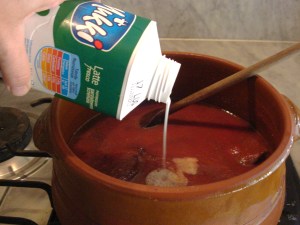
Add tomato sauce,1 cup of water and milk. Prop lid of pan with wooden spoon and allow to simmer on LOW or Warm heat for 3-4 hours turning sauce occasionally (every 20 minutes) as to not to burn the Ragu. 

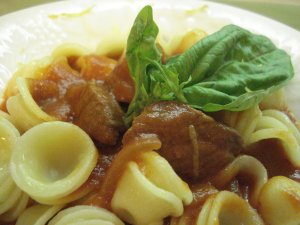
After 3-4 hours of cooking Ragu, Add 10 chopped basil leaves to sauce and remove the Ragu from the heat.  In a separate pan boil water and add your favorite pasta. The Orecchiette (little ears) pasta or Tortellini is commonly used with the Ragu ` Sauce.  This delicious married combination  originated from the city of Bari the beautiful southern region of Puglia, on the breathtaking Adriatic Sea. 

Drain pasta of all water and return pasta to pan.  Add 2-3 ladles full of sauce to pasta and turn in pan .  Spoon out pasta onto dish,  pass with 1 tbsp parmesan cheese, add one ladle of sauce on top of cheese.  Add 1 tsp of cheese to top of sauce and place a fresh basil leave for a beautiful presentation. 

Serve with meat on side.  Click on Waldorf Salad to complete this dinner!

By Kimberly Crocker

Old City of Bari and Homemade Pasta